37
@37beverly
Pat, Is this the one from Roadster Supply (or something close to that)? Does it need the residual valves installed in the lines? Everything I have read says the residual valves are needed when the Master cylinder is mounted on the frame. They recommend 10 pound.
Also, I would like more details on your Ford brake modification to fit the Cord.
Please call me or email, I'm in the directory and have done business with you before.
Scott Davies
Yes this is from the Roadster Shop. I did not install a residual valve. I think there isn't a need to have a proportional valve unless you have rear drum brakes and disc in front. The cylinders are different front and rear on the Cord to allow more front brake action. I am not sure why mounting on the frame vs. a firewall makes a difference.
Pat Leahy
Does the residual valve for a frame mounted master cylinder prevent brake fluid from the higher wheel cylinders from going back to the master cylinder when the brakes are not being used. I understand it functions somewhat like a check valve.
Tom
Interesting, doesn't the fluid return to master cylinder after you release the brake. Wouldn't you need this for a single reservoir? Most modern cars have the master cylinder mounted higher than the brake cylinders.
The original Cord master cylinders do have some type of internal check valve.
????, any more comments on this.
Pat Leahy
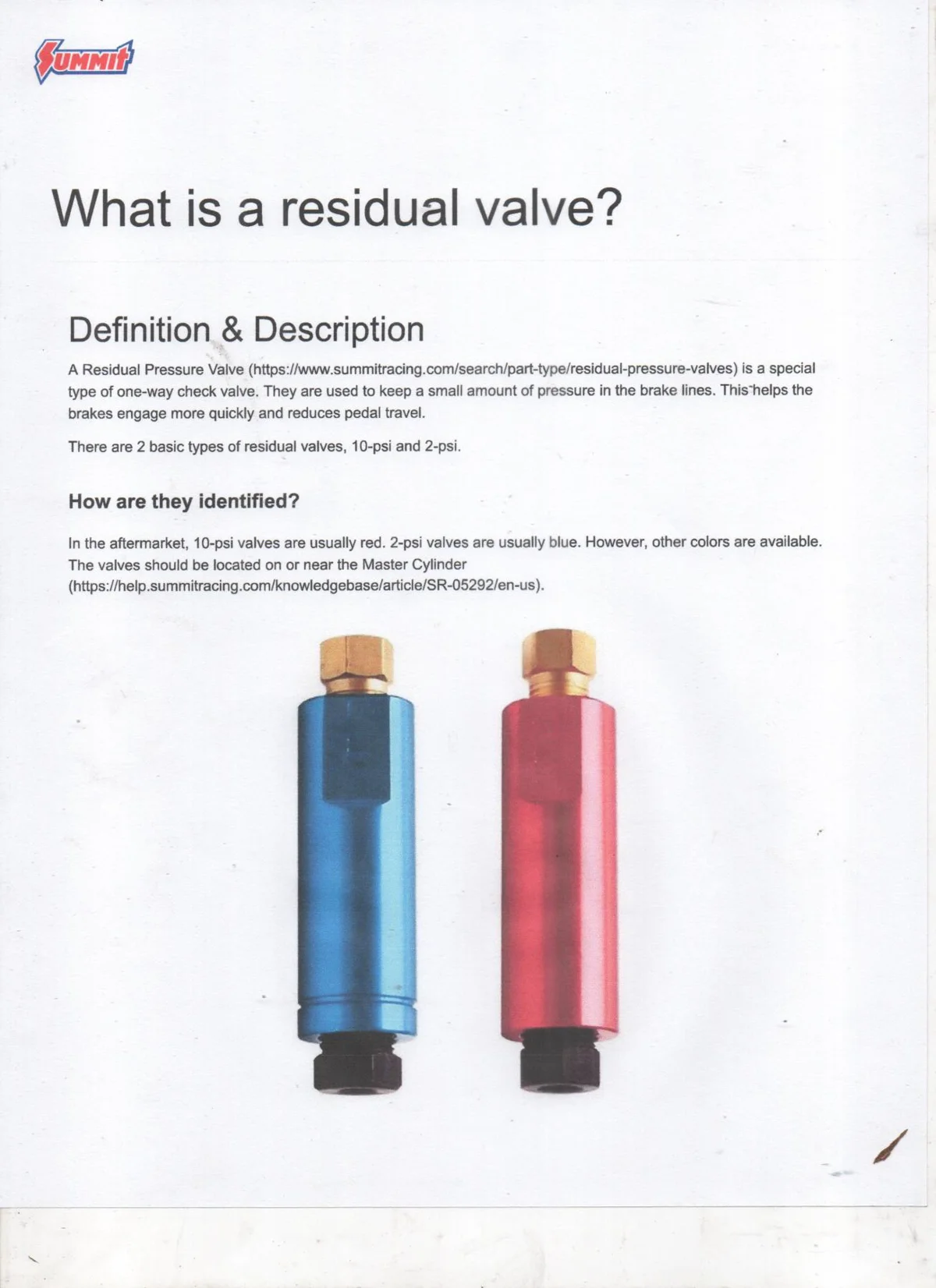
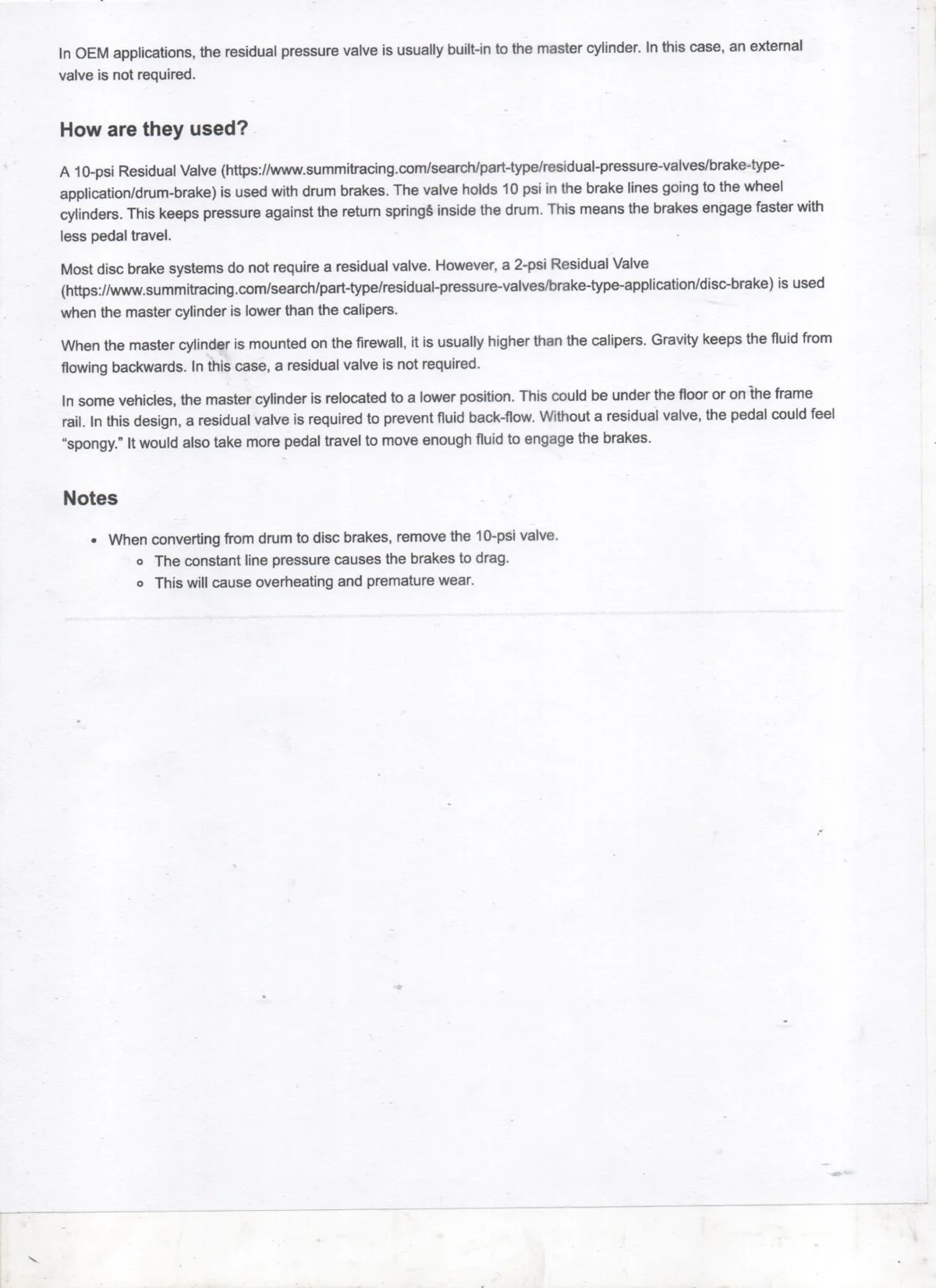
This will explain it.
Tom
Residual pressure valves were a thing on most if not all drum brake cars no matter where the master cylinder was mounted. By the 1960s the residual pressure valves were usually hidden under the tube seats in the master cylinder where the brake line(s) connect. That is why the tube seats were usually pulled out during a rebuild, to change the valve(s). Some master cylinders may have had the valve in the bottom of the cylinder bore. I don't know how Cord did it, but they probably did.
External valves like those red and blue ones were not seen much until recent years because the valve(s) were internal to the cylinder. On conversions, one had to be careful to match the cylinder to the type of brakes because disc brakes could not have the valve. They would drag. Drum brakes do not drag because of the return springs. A Disc/Drum dual cylinder would only have a valve under one tube seat (for the rear drums), while a Drum/Drum dual cylinder would have valves under both seats.
Keeping a little pressure in drum brake lines helps with pedal height a little, but the main reason was to keep the wheel cylinder cups tight against their bores so they didn't take on air. When cup expanders for the wheel cylinders came along in the 60s or 70s the residual pressure valves suddenly mattered less, but the automakers used them right until the end of drum brakes.
I imagine we see these external valves like the blue and red ones because 4 wheel disc brakes have become the norm, so maybe there are no residual pressure valves in aftermarket master cylinders now? I don't know. I imagine the 10psi valve is for drum brakes. I was taught the factory systems were 12-14psi. I doubt it's critical. I became aware about 5 years ago that residual pressure valves are sometimes used with disc brakes now, a huge no-no when I was learning this stuff. That's probably what the 2psi valve is for.
Proportioning valves are a whole other completely unrelated matter. They are usually found on cars with disc brakes. On cars with drums both front and rear, proportioning is usually set by the bore size of the rear wheel cylinders, no proportioning valve is needed.
EDIT: I found a drawing of the type of residual pressure valve that lives under the tube seat, and also a picture of the type that lives in the bottom of a master cylinder bore.


Thank you for the information.
Tom
To join in the conversation, you must be a club member.
You’re welcome to read and like every post. Members can reply and start topics of their own.