FJ
@Fjderosier
Members of the ACD Club are currently working on an updated version of the booklet called Cord Model 810 -812 Transmission Manual by Sid Ayres.
I suggest you contact Jim O'brien in Pennsylvania, for the new book.
cordman@dejazzd.com
It's a good idea not to rush in but be patient and do things one step at a time, that is how I sorted mine out.
Good luck from Australia.
Welcome to the club and being a new owner. Please tell us about your car. Where it came from. Convertible or sedan.. Who owned it before you and where are you located. Sometimes another member lives near you and can help with issues.
The trans issue can be daunting. But careful step by step will fix it easily.I suggest you disconnect the trans shifting arm from the front of the trans and then shift the car thru the gears. That may point to the vacuum can being stuck or a bad solenoid in the passenger side solenoid block. There are 4 separate solenoids in that rectangular piece. In all honesty it sounds like your clutch cutout switch might be out of adjustment but do not start moving it yet until other better members chime in with advice. Jim Obrien is VERY GOOD with these trans issues.
As for the gas tank I too believe the float has a hole in it so it fills with gas and sinks. They are easy to repair but just replacing it works the best. Mine has too many cracks in the brass cylinder. I tried soldiering it but it got too heavy. I have not replaced it yet but I have it apart on the bench if you want pictures. Just make sure the ignition key is turned off before working removing it. An electrical spark can ruin your day.
Everyone would love to see pictures of your car too
 
 
Gary Parsons
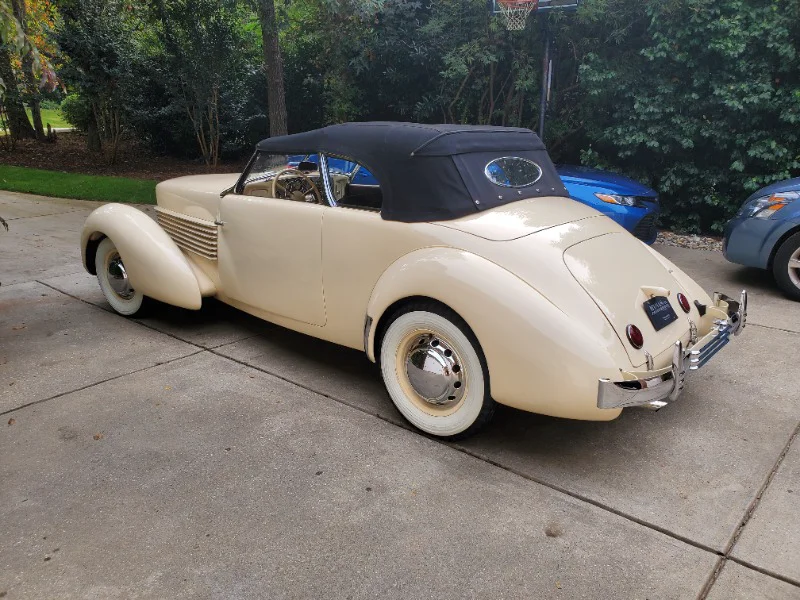
Thank you everyone for the replies - very much appreciated! I uncoupled the linkage at the transmission and manually moved the transmission to neutral. After this, I was able to confirm the unit moved into first, neutral, and then reverse - and then stopped with any further exploration as there now seem to be issues with the carb as fuel is coming out from a number places it shouldn't! (Frankly, I am happier to deal with that) In any event, progress, perhaps, in that power does appear to be going through the selector switch and the problem lies elsewhere. To answer the question about the car itself, it is a phaeton with chassis, body, and engine numbers 1339H, C-91 368, and FB2454 respectively. I believe it will be known to the the club as it was formerly part of the Pettit collection, but it is not listed in the Cord Complete book and is suggested to be an unsold '36 sold as a '37. I am located in Raleigh, NC
Hi FJ, Congratulations on your "new" Cord! It sounds like you are going to be on the steep part of the learning Curve on shifting. First off here is a link to the wiring diagram for the shifting system:
http://automaven.com/Technical/_Gearshift_Wiring/wiring_diagram8.pdf
Get this printed out and keep several copies, including one in the glovebox of the Cord. Studying it should answer a lot of your questions and help you in the troubleshooting.
 
It sounds like you are having engine troubles, while you are checking take some vacuum readings. You should be over 20"Hg, at idle, if not you need to tune up the engine..
 
You asked about the shift switch on the column...in the last Newsletter is an article on taking it apart and inspecting it. In the next Newsletter will be an article (if I get it done in time) on putting it back together and testing it. I'm working my way thru the shifting system, one component at a time.
 
AS you are having trouble with the shifting give me a call, my number is in the directory and inside the front cover of the NL. I'll be happy to walk you thru getting it shifting properly.
Jim
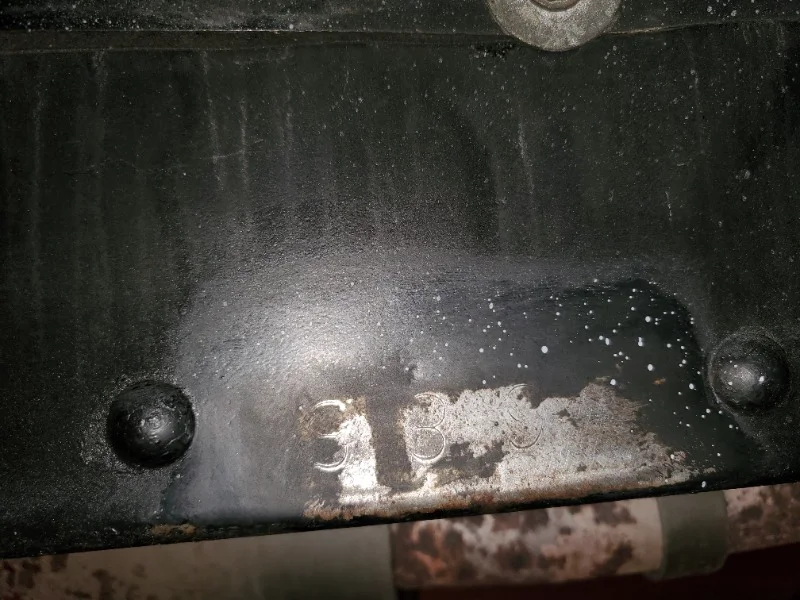
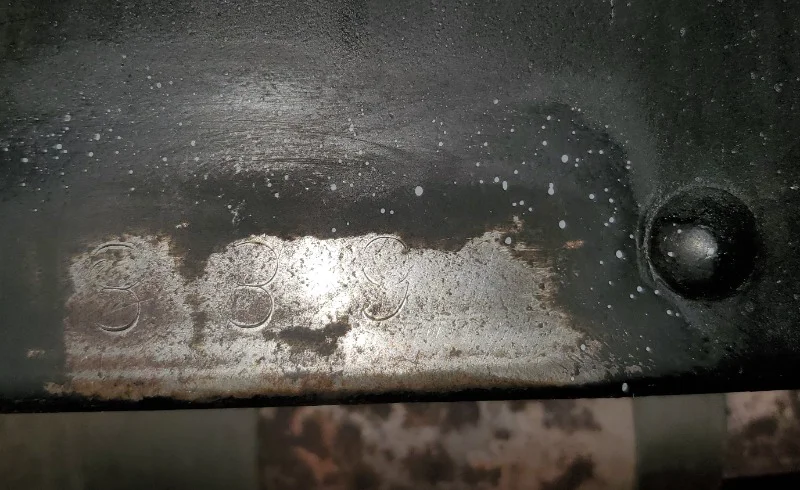
Thanks for the information. I am a more than a little interested to know what "made up" might mean... I checked the R stub frame - there seemed like something under the paint in the area indicated and so I very carefully, given the advice, removed the paint with some acetone and paper towels. There does indeed appear to be three digits stamped after removing the paint. They seem to fairly clearly be 339. I suppose either or both of the '3's could be '8's but to the best I can tell, it's "339". So are you saying someone other than the factory stamped the frame? I've attached a picture of what I found...
Actually, maybe I need to correct myself. Blowing up the photo and looking at the centers of the first 2 digits appears like the circle is curving both up and down from the center. I've tried to point this out on the attached picture. Thoughts? Is this correctly '889'?
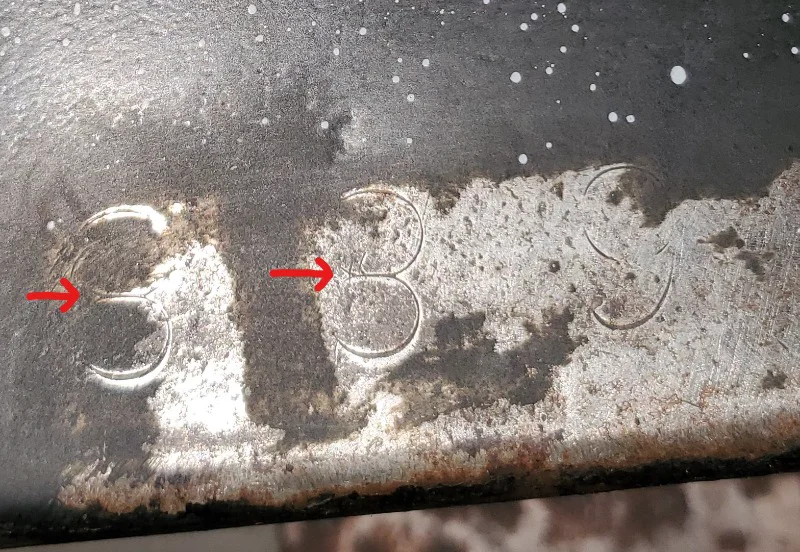
I concur this is stub frame 889. Sometimes shining a flashlight on the sides of the numbers reveals more.
Now the archaeology of the car serial numbers starts. But no matter... You have a Cord
 
 
Gary Parsons
I cleaned the stub frame a bit more. The naked eye struggles to decide what the numbers actually are and probably explains why the Commonwealth of Virginia riveted a tag on the body saying the serial number is 1339 under the ownership of William Pettit. But, enlarging the photo with this latest cleaning really seems to confirm "889" are the correct stamped numbers, not "339". If you look at the center section of the digits, you can clearly see the stamping curving up and down to form the 2 loops of an '8', even though the full loop is not truly visible. The upper loop of the digits also seems to curve a bit further down, more akin to an '8' than a '3', especially in the first digit. I am convinced the stamped digits are 889... Now, what to do with my DMV is the more difficult question as I am loath to perpetuate the error, but afraid DMV will be a royal pain. They have been nearly universally problematic on all my various collector cars over the years.
wcoye1@gmail.com
919 561 4894
This post to this fascinating study in Cord Model 812 automotive archaeology is primarily to point out and praise the amazing mind and memory of member "Roads2run" [ i.e. Tom Hartz of Nashville, Indiana ]. A partial explanation of Tom's recall skill is the fact that he once owned standard phaeton Serial # 1887, only two numbers earlier than the car under discussion/examination. #1887 had been owned back in 1977 by one J. Aylward of Massachusetts. At that time it had been converted to rear drive By the time of Tom's ownership (or during his ownership) the original engine #FB2546 had been replaced by #FB2396 and external exhaust had been added. Throughout Ron Irwin's records the CMC Body number remained unchanged as C 91 527.
All of the above is interesting but a reference to Engineering Changes @ Page 32 shows an entry by F. E. Winchester dated 2-11-37 showing that car with S#1886 was the first standard car utilizing the new generator K11233 and associated changes in voltage regulator , attaching bracket for generator and new generator belt and cable assembly. This was just one chassis ahead of #1887 which Tom Hartz had owned.
Space and time this evening does not allow more detailed discussion but I{ am struck by the large number of phaeton bodies Cords assembled during the spring of 1937 and the running sequential nature of their production. This is a topic for another day. Carry on , Jack Richards #1080 in Missouri.
Regarding serial numbers for phaetons, the earliest listed in Josh Malks' book Cord 810 / 812 , The Timeless Classic is 810 1926 H
With you gear selection problems you will have to check everything in the circuit and conduct test trials. Mine had a few problems due to a worn keyway on the cross shaft at the front of the gearbox. It was tight when cold but could move a bit when warmed up upsetting the syncronization.
Be patient, you will get there eventually.
Wow... as a glutton for punishment and someone who also has a Cord on a bucket list, this thread has been edifying . After reading this, a sane person would run away as fast as possible... but for me, the lure of such a Cord remain intense. Who knows, I may be looking for help and counsel one of these days.
I have owned other cars that I characterize as a "tinkerer's delight" so the mysteries of a Cord is all the more alluring.
To join in the conversation, you must be a club member.
You’re welcome to read and like every post. Members can reply and start topics of their own.