VL
@VLM
Thanks for making a very good point in your post. I too would like to see "originality" photos of everything. I'm not a professional restorer but... Why have to continue restoring my car because I got something wrong. Just today I was reading the ACD FB page. It showed a picture of two of the greats that have passed. They were counting the links in the gas cap chain during judging. Nobody wants to restore only to find you lost points because you have one too many links in your chain. I asked for clarification on whats exactly needed in this area too. I want to restore my car once and do it correctly. Mostly for myself but so the next caretaker has a car that is correct.
 
 
Gary Parsons
Can you believe, when the cars where built, that the factory counted the links in the chain? Today manufacturing new cars, Yes. In 1936-37, don't believe it. Judging getting like National Corvette Restorers Society.
CORDiallyMike
VLM - These cars were not mass produced, they were basically hand built cars on an assembly line. Over the two year production they changed almost every part on the Cord at least twice, if not three or four times. Therefore what is correct on one car is not correct on another. In addition most of the changes were running changes.
 
You are only going to find out what is correct for your car with a lot of research. The judging standards is a start to tell you what the judges are accepting but that doesn't mean is the way it came on your car.
 
In short it's almost impossible to put together a photo library of originality.
Hi Jim.
 
Let's agree to disagree about it being impossible to put together a photo library of originality. One of my cars (which was in terrible condition and is now being hammered into a Cord "continuation" car) was the 20th car made. We thought originally that it might have been a prototype but thankfully it wasn't (as nobody would forgive me cutting up a prototype). It turned out that a range of parts on the first cars were salvaged from disassembled prototypes. For example, the car had aluminum cast (rather than stamped steel) inside window frames as well as a spare tire shelf that went right across the trunk. It took the sleuthing of Rick Hulett, Dave Ryan, John Baeke and Stan to figure out just what took place. With an authenticity site, this could have been recorded and other members may know when the transition to stamped window frames and  spare tire shelf took place by looking at their own cars (or maybe they know already).
 
I live on the West Coast of Canada. If I have a car which I want to compete at Auburn, I will only have one shot at it. It is unlikely that I would make such a trek a second time. There will not be multiple opportunities for me to figure out what the judges like or dislike based the number of times that I attend Auburn. The object is to show the craft of the restoration, is it not? The cars had a lot of handmade elements to them but not all that much. Dave Ryan has worked on a range of very rare Cords when he was at RM (Berlines, Sportsmans, Customs, etc.). We have discussed at length the ways that the cars differed over the years but there is no reason why such variations canÔÇÖt be recorded and shared. The object of showing at ACD is to display as perfect a car as possible relative to how it left the factory, no? ShouldnÔÇÖt we all be working together to share our knowledge of how the cars evolved from the first one off the line to the last one? A lot of people enjoy people enjoy tracking down the minutia of just how the cars were made but it seems a shame not have an outlet to share this knowledge. When Rick was working on his revised trunk kits just before he died, I asked him why he cared so much to get things exactly as they were when they left the factory. He told me that he did this out of respect for the workers who made the car. He felt that their workmanship could only be honoured by us working to reproduce it they originally made it. I can buy into that line of thought. I think that is why Rick was so generous with his knowledge to a complete stranger (as I was the first time that I called ÔÇô we never met in person but spent dozens of hours talking about how the cars were put together). One of our earliest conversations was him making it clear to me that my door pleat count was wrong (22 not 21). I always counted 22 but he assured me that I only had 21. Far too much knowledge disappears with lost ÔÇ£mastersÔÇØ. IÔÇÖd like to see that change.
 
I donÔÇÖt expect everybody to be on board with an originality site but I believe that many would find it of interest and would like to contribute. After speaking to my programmer about the issue, he suggested a series of blogs on the web site by each part of the car (door, trunk, and so on). People could post pictures and commentary to any of the blogs. Once there was agreement on what was original (or there were details of how things changed from car to car), then the relevant photos would be transferred to a separate section of the site which would be more ÔÇ£authoritativeÔÇØ so to speak. It would still be open to change but it would certainly provide a foundation. I should have a mock-up to share in a couple of weeks. My interest lies solely in the 810/812 but IÔÇÖd be happy to share the programming with anybody who would like to do it for other ACD cars. If anybody would prefer to do this instead of me, IÔÇÖm fully ok with it. I have no attachment to owning or controlling it, I just want to see it happen.
 
Vic Marks
Vic those are well spoken words. Jim makes a good point about in two years so many things changed. So I feel as you do. Documenting this in some way can help all of us. I have a book showing the changes with dates from the factory.But capturing information before we pass is the ONLY way to save it.
 
 
Gary Parsons
Vic, I agree the information would be nice to have, however a lot of it has been lost to history. First the factory didn't keep records of a lot of the changes since their objective was to get cars out the door, not document it for historical records. Second there are very few original cars left. Most have been restored at least once and the rest were daily drivers. From 1940 to the 1960's people who had them were just trying to keep them running and did whatever they had to do.
 
You really can't go by how the cars today. There aren't enough original cars left to be able to say how it was done on all cars and where the changes were made. All we can say is on Early cars it was this way and later cars it was that way...and in some cases the middle cars were another way.
 
Early in my addiction to Cords I was able to talk with many of the people who had been studying the cars since the 1940's. They were still learning and finding out new things and finding stuff that didn't fit in to any of the known information.
 
If you want to compete at Auburn you should follow the judging standards. If you want to restore a Cord to "as it came from the factory" you will be very lucky to get a second place (the cars today are much better then when they came from the factory).
 
The ACD Club is more about preserving the cars and the history then the judging.
John and all, "authentic driver" is what I am striving for. My Westchester was judged at the 2018 reunion...one of only three 810-812s submitted for judging. Lots points for some nit-picky things which is okay as long as you know what the nit picky things are going into the judging . I consider myself a relatively new Cord guy, I have had my card about 6-7 years. Because of economics I've been trying to make my car authentic piecemeal. I'm with Gary and VLM. I want to do my fixes once, correctly.
This forum has been immensely helpful but because of all the menusha I think many of us don't know what we have done incorrectly or for that matter don't even know what needs to be done. Case in point engine splash guards . Didn't even know there were such things until I lost points for not having them. I could go on and won't. Just if there was an authenticity reference available I'd be willing to shell out some bucks for it.
Bill
Jim: I think that we first have to define what each of us means by originality. The ideal for an ÔÇ£originalityÔÇØ site would be pictures of unmolested cars. The close to ideal solution to me is that if we canÔÇÖt find a photograph an unmolested car, then we photograph parts of cars that have been restored to a standard that contributors (by consensus of some sort) agree is as close to the original as is feasible in a restored car. For example, I have a car that was parked in 1957. I know that it was not changed or driven since then. I can certainly post a lot of detail photos from a car like that. Given that the car was on the road for 20 years, things like the exhaust were certainly tampered with. But likely, there are lot of things that are original to the car. Rick Hulett shared a lot of photos with me which he believed showed what certain parts of the car should look like when restored. He was a stickler for detail, so itÔÇÖs likely that those photos are correct. But if some people didnÔÇÖt agree, we will certainly post critical comments in an effort to reach consensus. I think that a lot of people have some remarkable pieces of documentation that they would choose to share. For example, Peter Morgan shared with me the original drawings for the Cord wheels when we were discussing the fact that Don Wohlwend has passed on to me his business of making the alloy billet reproduction wheels (which I have not produced as yet to save people inquiring ÔÇô his source for the turning of the wheels shut up shop and I have not been able to source a competitive price elsewhere as yet). IÔÇÖm sure that there are remarkable contributions that can be made by many others in the spirit of sharing their knowledge. We all share a passion for preserving the cars and their history, but the point about bringing up the judging is that so far, that has been the only avenue for finding out if a car has been restored properly. My hope is that the originality website will provide a second avenue for understanding how to ÔÇ£properlyÔÇØ restore a Cord (should any of us want to do a car as close to originality as each of us are we are capable of doing) rather than waiting to be judged ÔÇ£wantingÔÇØ. And although the judging is not the primary focus of the ACD, it is certainly the highest profile of its activities, and letÔÇÖs be honest, most people get a bit ÔÇ£juicedÔÇØ by competitively showing their cars.
 
In regards to showing at Auburn, I was using it as an example. Although IÔÇÖm working on three restorations, my primary reason to bring them to a show like Auburn to share the uniqueness of each car with others who are passionate about the Cords. As for the issue of judging, I understand that ACD has certain standards that they look for in judging a car which varies from what the judges at Pebble Beach or Amelia Island might look for. Some shows are looking for the fender gaps to match what came out of the factory and others look for perfection in the continuity of the gap width. The one thing that all judges are looking for is that the parts are authentic in their construction and appearance; that all of the bolts look like the bolts used in 1936-37; and so on. I think that Bill Coye made this point most eloquently. He just wants to know that splash guards should have been there and what they should look like. Ditto for all us.
 
Bill: There is no reason to ÔÇ£shell out some bucksÔÇØ for this site. There are no plans to do a book. The idea is to provide photos and commentary which will help people like you and I who donÔÇÖt have local access to knowledgeable specialists due to geological distances. It is meant as a site that people can use at no cost; as a place share information. I will absorb the cost which will likely be quite modest.
 
Vic
I second the motion. It should be possible to create a searchable originality photo archive.
You mentioned that Rick Hulet was a stickler for authenticity. Has anyone continued his legacy? An archive of Rick's pictures would be invaluable to those of us trying to get as "original" as possible.
Totally agree with regards to Auburn and Cord cars , original photos and advertising , John please post this in the Auburn forums as I have some information to contribute.
Ivor.
I posted an inquiry to the "General Discussion Area" page - perhaps everyone could chime in with their enthusiasm.
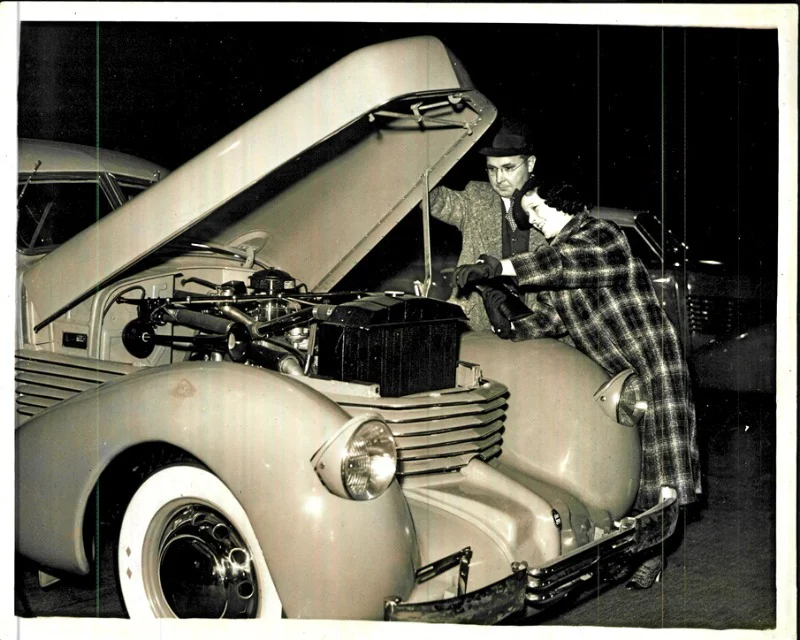
Its a 36 car but maybe a 35 car made for the first car show. I can't enlarge enough to see if the firewall is hand built. This car has the vented wheel covers. It has the cowl oil and coolant fillers. It has the three brush GAR 4630 Autolite generator with the TC top mounted voltage regulator number VRP 4006-C.... There is no hood brace from side to side that I can see. I see the headlight body painted body color and it rides on Double Diamond tires probably double whitewalls. The coolant return tubes are chromed and the horns have the screens either chromed or cad plated along with the trumpet nut. The air filter on the carburetor is an early small one. And appears there is no insulation on the exhaust pipes from the manifolds. The radiator cap is either wrong or it was changed to the cap with the arm that must be on the passenger side to be correct. Difficult to tell if the fuel pump is the early one with the metal top instead of the glass bowl. Anybody see anything else???
 
 
Gary Parsons
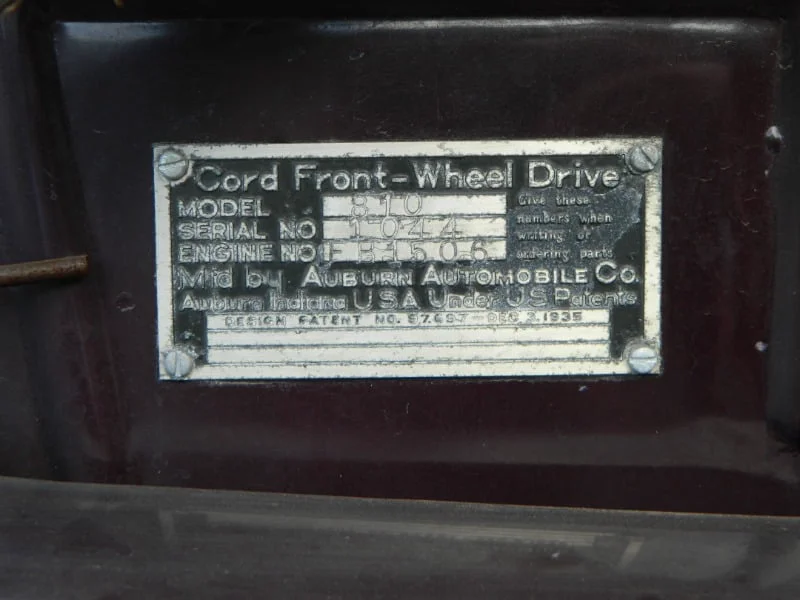
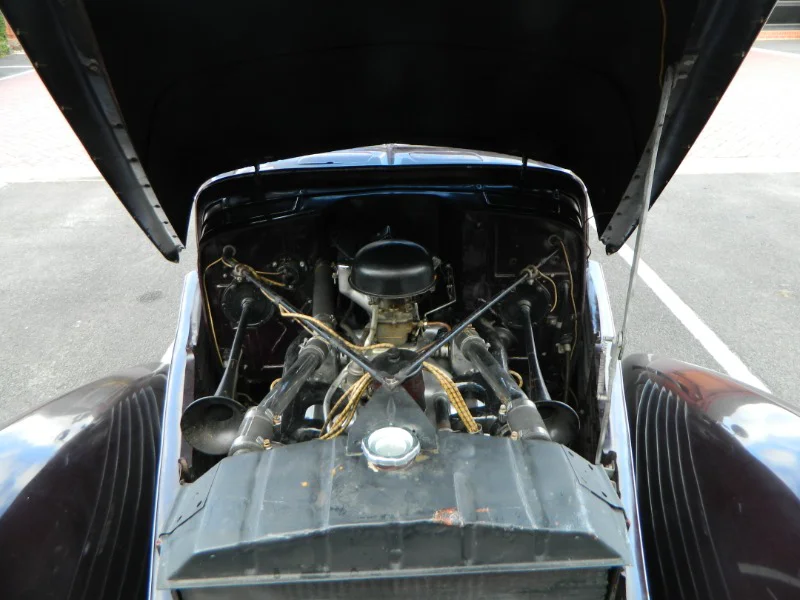
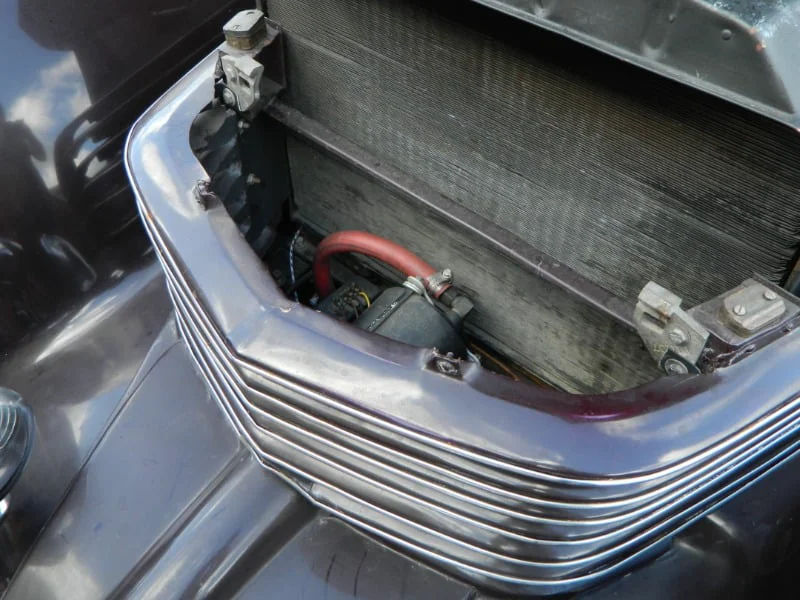
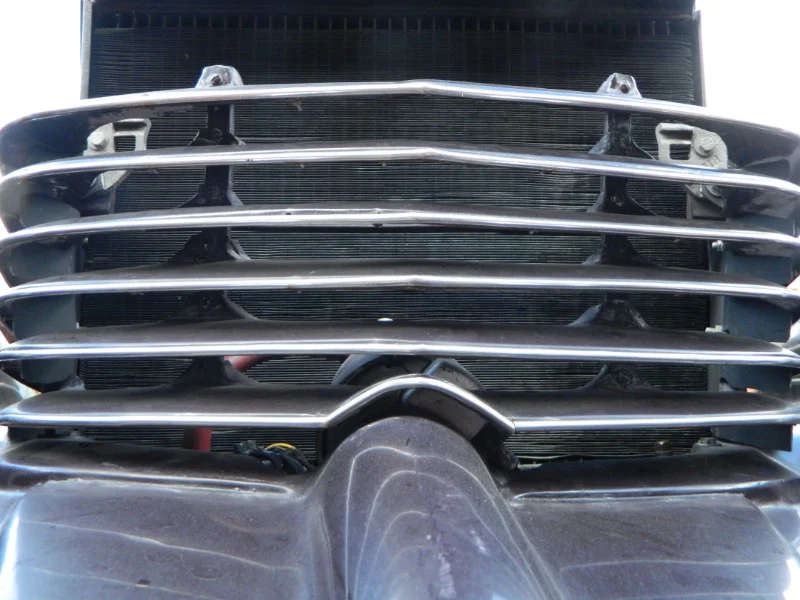
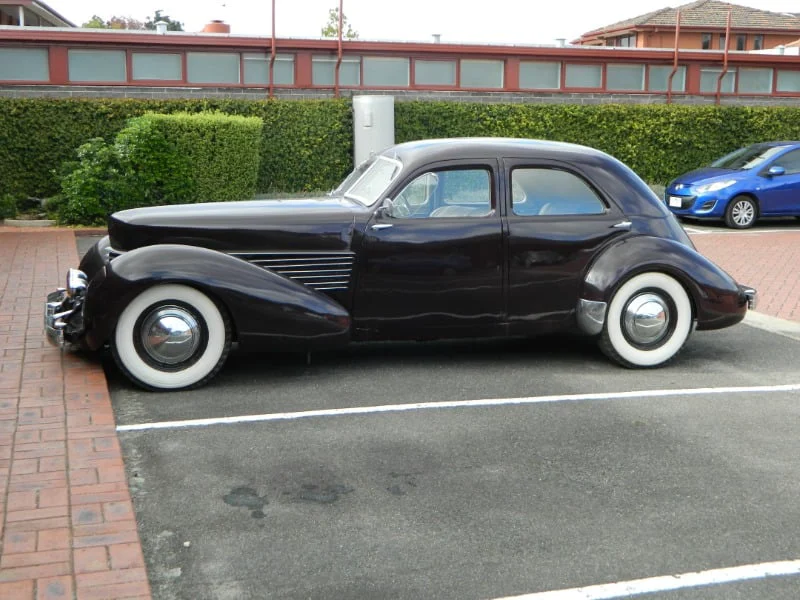
Looking at the firewall the "pressed stiffeners" have square corners hence it must be one of the Hand Built cars. It also has smooth bumper side panels.The grill does not have the turned up edge at the back of the louvers like all "normal production" Cords.I believe this must be one of the Hand Built cars and maybe one of the actual Show cars.The attached pictures are of Serial No 810 1044 A which now lives in Australia.
To join in the conversation, you must be a club member.
You’re welcome to read and like every post. Members can reply and start topics of their own.