RL
@rlwardne
I too am interested in what comments come in. When I first acquired my Cord back in 2007 the transmission filter was full of coarse metal shavings which cam e through the oil pump and screen before it. I decided to make a new screen with smaller holes however I will have the check the sizes of both screens tomorrow. I had thought about finer metal gauze but figured it may be to frail. High powered magnets were added to all drain plugs to trap any loose metal particles. I will post the screen hole sizes tomorrow.
Original screen plate in gear box had holes 0.100" diameter
New screen plate has holes 0.075" diameter
After seeing the amount of shavings in the filter when first removed I expected the oil pump gears to be destroyed however they were in excellent condition. The cover plate had score marks that were sanded out on a face plate using fine emery paper and kerosene.
One of mine has a screen, but way to large. These pumps have fairly tight tolerance like .005. In my mind a guy needs screen for 100 to 140 micron. Both incidents on my car were from running metal particles thru.
 
I would venture to say that a lot of cars dont have operating pumps unless they have a way to monitor the pressure side. I have a gauge coming off the trans filter. It was around 30 psi with fairly heavy oil, in 10 miles it locked and wiped out the tang again. This whole system is backwards. What Id really like is an engine driven pump and not have to worry about it at all. I do have a mod in mind using a screened filter and pull the oil from the trans case and tap the the pump inlet.
In every engine I have ever taken apart I find an oil pump pickup screen BEFORE the actual oli pump. It seems like this is a bad idea. But looking closely at it we find any oil, even if its dirty oil bypassing a plugged filter is better than no oil. Some of the later built Cord tranmisiions had a raised oil pickup designed into the bottom of the trans case. It was a hope that pieces of the trans rears would settle there and not go thru the trans oil pump. Today we have some incredibly strong magnets. So placing them along the bottom of the trans may "collect" the harmful magnetic pieces. I have the magnetic drain plugs in my trans and engine oil pan. But more is not going to be an issue. On the bottom of every car or truck I drive daily is a speaker round magnet. I know others and place the same magnets on the bottom of the oil pan. Then when its oil change time you remove the magnets and drain the oil hoping the collected metal fuzz washes out. Ever change the oil in any auto trans? See the magnet inside has all the fuzzy metal stuck to it... They work..
Gary Parsons
Putting a filter after the pump is standard engineering design practice. You do not want the filter before the pump in this type of application. What you want before the filter is a "strainer" to keep large particles out. If the transmissions are rebuilt properly the only large particles you have to worry about are the teeth when you break second gear. At that point you are rebuilding the transmission and pump anyway.
 
Best practice is to put a good magnet (rare earth) in the pipe plug at the front bottom of the transmission. This will catch any large particles as well as a mess of smaller ones from grinding 1st and reverse.
 
Putting a filter in front of the Cord transmission pump is asking for trouble. You will not be able to get the proper oil flow thru it.
I have seen a Co. or Companies that sell a magnet
that goes around the oil filter for modern cars. Since all oil goers through the filter on modern cars probable not a bad idea. I know some oil goes through the bypass.
Cordially Mike
I am presently working on my transmission oil pump. It is completely trashed. I am plugging the passageway from the transmission to the gears and bringing the oil outside the pump and past magnets before going back into the pump housing and gears. I know it is not "original" but anything would be better than the original design. I plan to build a reliable driver.
Tom
Mike - What is the magnet on the oil filter really doing? The filter will take out any metal in the oil so the magnet is redundant. The only way the magnet would do any good is if the filter ruptured allowing the oil to go thru without being filtered. In that case you have bigger issues.
JIm
Mike - What is the magnet on the oil filter really doing? The filter will take out any metal in the oil so the magnet is redundant. The only way the magnet would do any good is if the filter ruptured allowing the oil to go thru without being filtered. In that case you have bigger issues.
JIm
 
Jim is is not exactly true. Nearly every engine oil filter is only "catching" the big stuff.. What damages the engine surfaces has always been the small unseen particles carried thru the filter by the oil. I know of only one filter that works on the small stuff. Its called OBERG... Its a screen only type element and it sure will filter the bad stuff out of the oil. Even a fresh rebuilt engine is rubbing off metalic pieces on the first stratup. The plugs up the screen to set the alarm light off telling you your in bypass and to clean the screen. Remember dirty oil is better than no oil. Even today on a cold stratup our engine oil is thick. So much so that it causes the oil to go theu the bypass. In my diesel the oil filter as with most filters has a built in bypass so the engine gets oil no matter what.. My oil filter adapter that is factory has an oil regulating valve in it. Without the regulator the filter will be blown off the mount.
Many filter studies have been done explaining how the filter media captures a certain size contaminant but allows smaller to pass with the oil..
I do understand a few things about our transmission in the Cord thru so many helpful tips on this and other members. Sadly if our synchro hubs over-travel causes the springs and balls to fall out. Then they drop down into the lower cluster. That causes any tans to need overhaul. Breaking off a gear tooth is as bad in the same way.
 
 
Gary Parsons
I recall someone posting how to make a screen for this area some time in the last 18 months. I did a search but.. Our manner of search is to say... Different... I can seldom even find what I KNOW I have posted or have commented on... So to those that have mastered this web site search engine. Please do some looking. Every combination using grease pump, trans oil pump overhaul or many others turns up nothing.
 
 
Gary Parsons
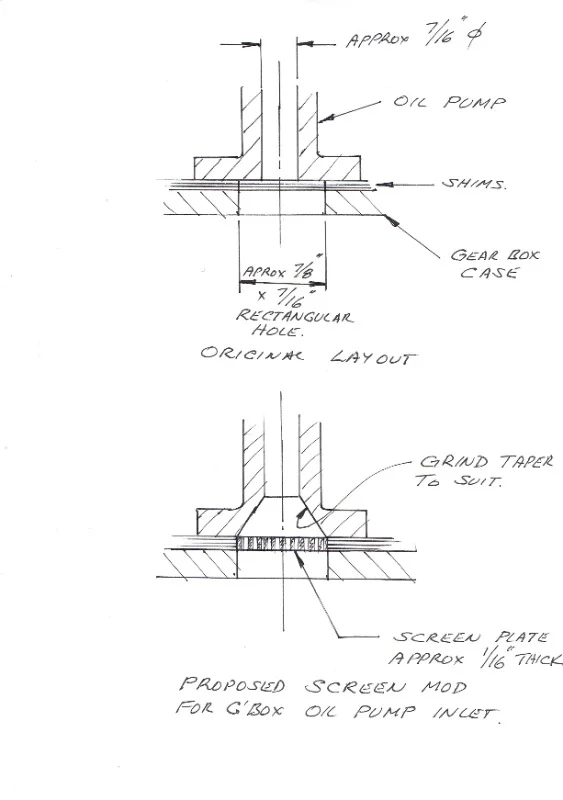
After reading Jim's comments regarding screens before the gear oil pump I had a closer look at the area and realised the inlet of the oil pump is much smaller than the rectangular hole in the gear case and shims, consequently any screen here will restrict the flow. It looks like a suitable screen can still be used however the oil pump inlet needs to be opened up. There is a lot of metal in this area than can be ground out so as not to restrict the flow.
I will be posting some sketch ideas soon.
My pump has been machined at the inlet area and they installed a screen and press fit a ring to hold the screen in. Only prob is the screen has a big weave.
My thought was to pull oil from bottom of case, Run to a screened fuel filter that is around 100 140 micron screen. The filter unit is decent sized that it will pass plenty of volume. Plug inlet of pump and tap side for inlet from the filter. All this will be below the fill line of the trans.
All the pieces are available from Speedway, Jegs. Summit
First off Gary we are talking about the transmission not the engine. These are very different lubrication systems and have to be treated differently. Second, after rebuilding numerous transmissions and taking detailed look at the failures, the only time I have seen the synchronizers over travel and release the balls and springs are when the original 3rd gear thrust washer fails (I have never seen of heard of the larger thrust washers failing) or it the transmission was not assembled properly.
 
There are two reasons the transmission oil pumps to be worn out. First is large parts (balls, springs and teeth) get in the pump and wipe out the gears. Second is the design of the pump and improper rebuilding. If you look at worn out pumps they either have chunks out of them from large particles or the driven shaft is wobbling and wearing out the body of the pump.
 
The drive shaft is the big problem. The rear portion of the shaft (between the gears and the drive tang) is held in place by a hole in the pump body. This is a drilled hole in cast iron with poor tolerance. When rebuilding the pump the hole is usually worn out. The hole MUST be put back (drill and sleeve is one method) in the correct location or the transmission shaft and the pump shaft will not be aligned resulting in wear.
 
The front of the drive shaft is held in place by the pump cover. There is no alignment between the cover and the body and the housing except the screw holes. There is nothing to take up a thrust load except the housing itself. The result is worn cover and housing.
 
The real key to the pump lasting is proper rebuilding and upgrades. I think it was Al Goodman who had some notes and upgrades on rebuilding the pumps. Also Doc Flywheel had some improvements. With these changes alone I have rebuilt pumps and had them go over 50,000 miles with very little wear. There will be an upcoming Newsletter article on this subject.
Thanks Jim for the continued information on thesegrease pumps.
I looked at the Henry Portz modifications to these pumps and feel it may not be the best idea. Henry changed the gears thickness from the original 5/16 to a full 3/8 inch. He also installed a bushing in the cover to steady the drive gear. Sadly he did not improve on the drive tang. I investigated this in depth. There is really no way to strengthen this area. If you make the drive shaft from 9/16 instead of 1/2 inch material you still have the pinion shaft at the bottom of the trans. There is just no way to make that area stronger. If you look at page 13 in this forum you can see what Terry Cockrell saw when he visited with Henry back in 2015. Also you can see my unfinished pump modifications. I had asked Cathy, Henry's daughter to look for this spacer Henry made up for the pumps he restored but she and A friend of Henry's name Roger Von Bergen could not find what I was interested in purchasing. She said I was welcome to come and look around. I really need to do that soon.
 
 
Gary Parsons
All of this reengineering is interesting and I pretend to now nothing about 810-12 Cords. A good friend of mine told me most problems with old cars are caused by their owners. I am in the middle of correcting some of those modifications in a car that was supposed to be a improvement and caused a failure. Tread lightly.
CORDiallyMike
 
I agree Mike. On my car I have "found" some really horrible "improvements". One stands out was the oil pan attaching rails where the bolts go thru to the block. Someone foolishly welded in pieces of 1/2 inch angle iron to strengthen the bolting rail probably to stop oil leaks. The pan bolts were so close to the angle iron that I had to use an open end wrench to remove them one hex flat at a time because the bolt hex contacted the inside of the welded angle iron.
Then to stop the cowl vents from leaking rain water someone welded in patches in the original openings. The inside lip was ruined by bending it for no reason and ALL the vents and the screens with all the attachments removed from under the dash. This has been my worst repair so far.I really do not know if I have the stills to repair it but will try. I can't make it any worse.
So far the easiest repair I have returned to original is the manual shifting of the transmission.Dad told me the owner he purchased the Cord from said he had NOT completed the transformation to complete manual shifting. Some pieces were missing. I have collected all the needed pieces missing to return my Cord to original electric vacuum shifting.
 
 
Gary Parsons
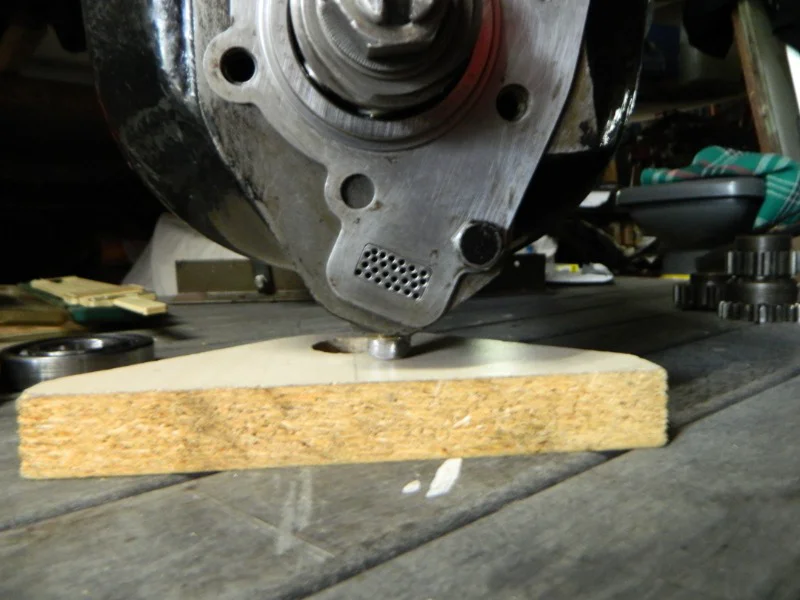
Attached are a picture of the screen as fitted in my gear box and my proposal to modify the oil pump inlet so as not to restrict the oil flow. I completely missed seeing the restriction introduced by the screen when I first rebuilt the gearbox ten years ago. Working alone is the problem although not really a good excuse.During the current restoration which has been a very slow process more attention has been given to specific areas as well as learning more as I go along. Here in Australia there is nobody who can supply information on Cords, thank God for the ACD Club, the Internet, Emails and the wonderful friends I have made in America and Canada along the way.I still believe a screen is a good idea to help protect the pump. The holes in the screen are 2 mm diameter and enough of them equal the cross sectional area of the pump inlet. By carefully grinding the inlet port as shown in the sketch an unrestricted flow can be attained. The casting thickness is sufficient to achieve this but extreme car must be taken.My overall aims are to restore the car, conserve it and protect it plus have a reliable driver.
Hi Terry, While your open area is equal to the inlet area of the pump you are forgetting the pressure drop across these holes. The oil is 140 wt which is fairly thick. There is nothing "forcing" the oil thru the hole, only the suction of the pump trying to pull the oil thru. Off the top of my head (it's been a few years since I sized an inlet screen) on an application like this I would look at the inlet screen to have at three times the open area of the pump inlet to minimize the pressure drop and not restrict the flow.
 
Just my 2 cents.
Jim
Jim, you have convinced me to forget about installing the screen. I suppose in hind sight I was very lucky that the gear box had not failed due to the flow reduction introduced by the screen with the smaller holes.
Thanks again for steering me in the right direction. Your comments are worth many "Dollars."
Hi Terry, I'm glad to see you are doing your restoration the right way, thinking about what you are doing and asking questions. I'm starting (when I find time) the restoration of my Cord with the same goal as you - I want a great driving Cord when I'm done, one that is as correct as possible. Remember when these cars were new they ran and ran well, people used them as daily drivers and went on very long trips. Not saying they didn't have problems but they were reliable cars.
 
I want to see photos when you are done!!!
CORDially,
Jim
To join in the conversation, you must be a club member.
You’re welcome to read and like every post. Members can reply and start topics of their own.