SU
@sunroofcord
George's comments are more practical than mine, but mine are more fun :-)
 
I did write back to Paul to point out that getting a Cord into the condition where it will take trips like the Seattle-Auburn one takes a long time, some money and lots of info from those who know (like our club Technicians.)
One more note: a survey of ACD car owners' driving patterns is included as an insert in the #10 Newsletter, which should be arriving in the next couple of weeks. PLEASE fill it out and return (no envelope needed) even if your car doesn't run (yet). That's important info too.
 
Thanks!
Thanks Josh and everyone else who has responded to Paul so far.
 
Following is Jim O'Briens response to Pauls questions which I hope he doesn't mind me re posting here.
 
Just thought his response should be shared with others who may have some of the same questions.
 
Hi Paul,
 
Jim forwarded me your email and asked me to respond. As an introduction I have a 1936 Westchester I bought about 20 years ago and totally restored myself and have been driving it ever since (except when I blew the engine, but that?s another story) plus keeping several other peoples cords on the road.
 
To answer your question simply for a 1930?s vintage car, when a Cord is running right there is nothing better on the road?when the Cord is running poorly there?s nothing worse on the road. Are the Cords Reliable ? YES when they are done right. Bob McEwan has driven his Cord to California and back (from Pennsylvania) twice without a problem, in 1975 and again in 2000 (or about those years) and every year to Auburn (about 1400 miles round trip). Doug Johnson drove his Cord to From New Jersey to Auburn every year for 29 years. I?m the newbie, I?ve driven to Auburn a few times, driven to the Eastern Spring meet about 15 times in different parts of the northeast. So yes they are reliable, it may take some work to get them that way, but it?s well worth it and the info is available to get there.
 
To answer some of your questions ?
 
Drive Axles ? The original ones work fine as long as they are not worn out. They will click going around corners ? they did that with as little as 200 miles on them from new. The original ones do leak grease, but again if they are rebuilt correctly they are fine. If you want there is a gentleman in Arizona that is modifying modern CV joints to fit the Cord. This modification works very well.
 
Over Heating ? The Cord is a highway car. It doesn?t do well in parades on hot days. There are numerous reasons for the overheating so there is no one fix. Some of the reasons are due to a 70 year old car, others are from new. A few examples ? the engine cores were never cleaned out properly at the factory, I?ve found tons of sand, core wire, etc. in the blocks during rebuilds; the radiators have not been rebuilt properly over the years, people adding junk on their cars to impede air flow, etc. Most of these can be cured by properly rebuilding the engine, putting a good core and bottom tank on the radiator and the addition of a fan shroud.
 
Shifting problems ? The Cord has taken a bad rap in this department mostly due to people not understanding how the shifting is supposed to work, how to trouble shoot shifting problems and due to idiots behind the wheel. First the transmission must be rebuilt by some one who knows and understands the CORD transmission. This gearbox is not like any other, the machining and set-up are very important. The proper set-up of the shift switches, vacuum system and wiring is just as important. The vacuum system must be tight, all the switches must be adjusted properly and the wiring installed correctly (the original factory wiring diagram is wrong.) Lastly the driver needs to understand a few things about the Cord transmission and drive it accordingly, such as,
 
- No sitting and idling for long periods in neutral
 
- No power shifts
 
- No over reving in second gear
 
- Shift in to low and reverse on the last half revolution of the front wheels
 
I won?t say the transmission and shifting are bomb proof, but it is reliable.
 
Cracked Wheels ? The front wheels do crack, especially the early ?light duty? wheels. They can be welded up and used on the rear of the car. The keys here are using the heavy duty wheels on the front, keeping the lug nuts tight and avoiding hard acceleration.
 
Losing hub caps ? This one has a very easy fix, 3 wire ties on each wheel hold the hub cap on very securely. If you really want to hid the wire ties go to a motorcycle shop and get the chrome plated ones, unless some-one looks very close they will never see them.
 
There are two other problems you didn?t mention that are common on Cords
 
Vapor Lock ? Cords are know to vapor lock. Again with a little bit of effort this can be eliminated or at least greatly reduced. First is proper routing of the gas line to keep it away from the heat. Second is insulating the exhaust system the way it should have been. Third is installing an electric fuel pump. I will have some problems with vapor lock on a hot day if I?m running down the highway and have to sit in traffic waiting to pay a toll. I just switch on the electric fuel pump and the problem goes away.
 
Hub Cracking ? The front hubs have been know to crack (not very common but something to watch for). An inspection every few years and you will be fine (or switch to the modern CV joints.)
 
The rest of the problems you?ll have are just old car problems.
 
How realistic is your goal ? VERY! Providing you are willing to go through the car and do things right. The other recommendation I have if you want a driver is to put radial tires on the Cord. They make a world of difference.
 
If the car is done right and set up correctly you?ll have a reliable car that can cruise down the interstate at 70 - 75mph all day long or is very well behaved on a back country road (at a reasonable speed). One note a standard Cord when tuned up will due over 100 mph (don?t ask how I know).
 
They are great fun to drive !!
 
I hope this has answered your questions, if you have any others, just ask. Good luck and let me know what you decide to do.
 
CORDially,
 
Jim O?Brien
 
Lots of good information coming my way. I am very excited. Thanks Jim!
 
Paul

I don't how many of you are aware of it but Tucker used left over Cord transmissions when he built his cars, electric hand shifter and all.
that makes the Tucker eligible for this thread.
 
The summer of about 2008 the NASA museum set up a display honoring a movie producer/director, and since one of his moves was Tucker they wanted to borrow our Tucker for the summer.
 
There a number of reasons a Cord will not shift properly. Old age is one, vacuum leaks, ignorant or lazy restoration, incorrect electrics, or sitting too long after a good restoration.
 
We had a beautifully done car, from Bob Pass, done in a dark blue. When we were getting ready to take the car to NASA it decided not to shift. " Hell no, I aint gonna do it," it says. Time would not allow us to trouble shoot and repair it, so I pulled out the rear seat and the access panel to the engine compartment. While my buddy drove the Tucker out of the trailer and into the building I was on my knees in the back seat area with a crescent wrench and pliers, shifting the transmission as he needed it.
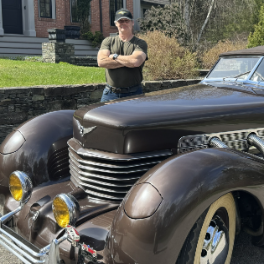
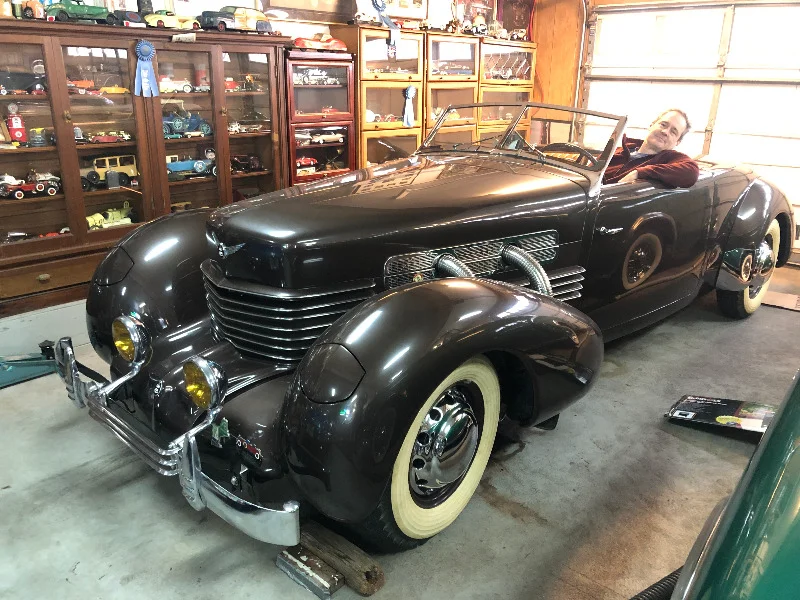
The way IÔÇÖve always shifted into first when the car is moving is while braking to a stop, depress the clutch and shift first into neutral keeping the clutch depressed and then when the cord is almost stopped and when the front wheels are making their last 1/2 turn revolution, I then shift into first.
Only way to check if your temp gauge is accurate is to check the temp in the radiator with a thermometer and see if itÔÇÖs close to what the gauge reads. Many of the cord temperature gauges are not calibrated correctly if they have been rebuilt.
A infrared heat gun is your friend and not very expensive anymore. But I still prefer the thermometer in the rad. Infrared is good if you are trying to diagnose a heat problem. If the weather is cool as you said you probably have a heat problem if it is 200.
CORDiallyMike
Thanks guys. I have a heat gun, and will give that a try, but the idea of a thermometer in the radiator seems more accurate. I was surprised I could lay my hand on the upper water tank with the temp gauge pegged.
 
Will also try shifting to neutral before going to first coming to a stop.
You might want to check the radiator tubes (between the top of the engine and the radiator). Your car is from the era when a lot of people put screens in the tubes to prevent the junk from the engine getting into the radiator and plugging it up. Check out the article in Newsletter #2 2020 (coming out soon). if they have the screens in the tubes and are partly plugged it would account for the engine getting hot and the radiator staying cool.
 
THe other thing would be to check the water pump is working properly.
After thinking some more about this I missed the obvious answer. Check your thermostats. It could be one is not opening properly.
 
Jim what temp thermostat do you recommend?
 
 
Gary Parsons
To join in the conversation, you must be a club member.
You’re welcome to read and like every post. Members can reply and start topics of their own.