

@Soccoach3
I have an 810 Cord and am using a Red Top Optima battery. It starts easily with the cranking power available.
The Optima battery is considerably lighter than the recommended lead acid battery and it is maintenance free. It is the only way to go these days.
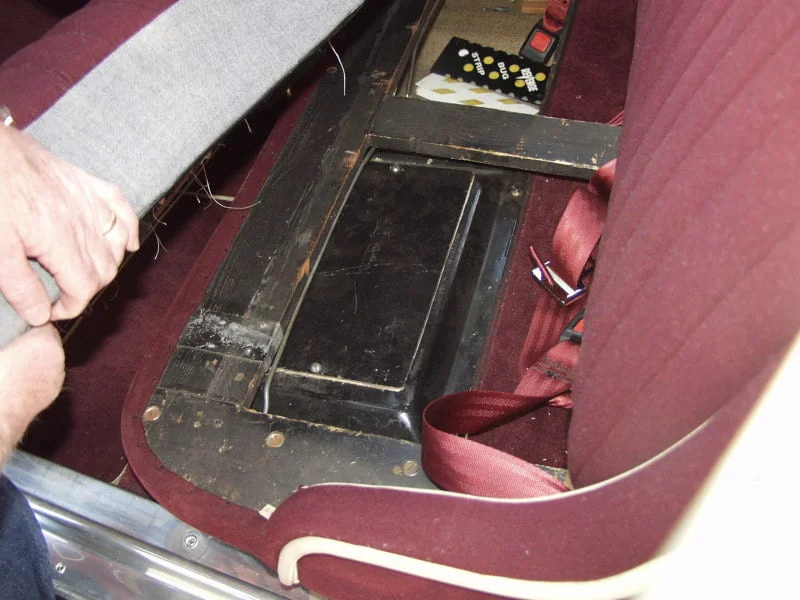
I am not sure where the battery is located in an Auburn . With the Cord the battery is located under the driver's seat. It has a removable metal cover.
Consequently eliminating battery maintenance is a real bonus.
The attached picture gives an indication of what has to be done to access the battery.
I would be very careful before doing so.
Not sure if your golf cart is electric or gas powered and whether your battery is simply for starting a small gas motor or whether it provides primary energy to a drive train but, in either case, lithium ion batteries operate in a carefully designed charging sweet spot outside of which there can be , how do you say, catastrophic results.
You might get away with it or you might not.
I wouldn't mess with them unless you are upgrading the charging system to one specifically designed for lithium. Stick to lead acid batteries ( either conventional or SLA or AGM like Optima) as suggested by Terry.
Thermal runaway is one of the concerns of the lithium ion battery: https://ul.org/research-updates/what-causes-thermal-runaway/
Several good posts on the forum on use of optima batteries.
I have a Journal piece saymg Fire Dtts are deciding to let lithium battery EV cars just burn out when they catch fire---just tow them to an open space and sI have a recent journal piece relating
Fire Depts are deciding to
let EV cars bur out---tow them to a clear space and let them burn out..and they require rivers of water to put out if they are reall yout. .*Journal article...
It also mentions one, cold to the touch, spontaneously on fire in the wreckrking yard...
Plus an airliner that had to make an emergency landing because of smoke in the cabin from a passengers device...
These batteries are not only torches waiiting
to self-light, but real killers, literally
Bud TierneySep 11, 2025 I have a Journal piece saymg Fire Dtts are deciding to let lithium battery EV cars just burn out when they catch fire---just tow them to an open space and sI have a recent journal piece relating
Fire Depts are deciding to
let EV cars bur out---tow them to a clear space and let them burn out..and they require rivers of water to put out if they are reall yout. .*Journal article...
It also mentions one, cold to the touch, spontaneously on fire in the wreckrking yard...
Plus an airliner that had to make an emergency landing because of smoke in the cabin from a passengers device...
These batteries are not only torches waiiting
to self-light, but real killers, literally
I'm no firefighter but I doubt that any department would recommend towing an already burning car to another space. I'd like to see that article.
Let the lithium battery fearmongering and pearl-clutching begin!
I'm running Optimas in all most all my cars. However, I'm starting to have second thoughts for a number of reasons. I need to gather my thoughts in to a coherent explanation. But my enthusiasm has been tempered lately.

IÔÇÖve tried Optima batteries, maybe itÔÇÖs me, but disappointing results.
IÔÇÖm not sure theyÔÇÖre friendly to storage needs. If you have one car and drive it often, probably not a big deal.
If you have numerous cars, they seem to not be as friendly.
My thoughts arenÔÇÖt gathered yet either, just some random comments.
My experience with red top OptimaÔÇÖs has been outstanding. You must use the correct electronic charger with these batteries. My mechanic gave me a dead Optima that he said would not take a charge. I used my Optima recommend charger and brought it back to life. I accidentally left my headlights on and drained my two Optima setup. My second Optima is the one my mechanic gave me. It took two days for the batteries to fully recharge. I have complete confidence in them. The recommended electronic chargers act automatically as a charger and a trickle charge battery maintainer/conditioner.
Milburn DrysdaleSep 12, 2025 My experience with red top OptimaÔÇÖs has been outstanding. You must use the correct electronic charger with these batteries. My mechanic gave me a dead Optima that he said would not take a charge. I used my Optima recommend charger and brought it back to life. I accidentally left my headlights on and drained my two Optima setup. My second Optima is the one my mechanic gave me. It took two days for the batteries to fully recharge. I have complete confidence in them. The recommended electronic chargers act automatically as a charger and a trickle charge battery maintainer/conditioner.
Stuart, I have given some thought to a 4 way switch since one of those batteries is more than enough amps to run alone. The problem is that the switches are all marine and huge.
Nothing wrong with lithium batteries so long as they are designed for the application they are used in.
Everyone goes on about EV's and fires but the same chemistry is in your cell phone and your cordless tools. Hands up who wants to go back to the days of NMiH in your cordless tools.
Almost all multicell lithium batteries come with an internal battery management system that provides an adequate safeguard. LiFePo batteries have a lower charge density but are way less susceptible to fires and are now the go-to system for residential solar systems . You don't read much about house battery fires.
I'll add to that that I have a jumpstart the size of a paperback in my boat that has saved me multiple times. It will also start your passenger vehicle. Powered by Li of course. Why I needed to use it multiple times is the subject for a boating forum but lets just say the miracle of the modern EFI 4 strokes is tempered by the hard no-start at voltages under 12V
The questions to consider are both the quality of the battery you are considering (Temu anyone?) and whether it was designed for your purpose . The 12V LI batteries in modern EV's are not designed to crank over a cold ICE engine . Nor are they designed to be charged by the relatively primitive charging systems in most of the cars we are talking about .
They certainly could work but then you are relying solely on the BMS to deal with usage outside the batteries operating envelope.
If there is a LiFePo battery out there designed to act as an ICE storage battery without modification to the vehicle's systems, I would definitely go for it.
I also looked at the marine switches and agree they are huge. I was unable to find a proper ( easily accessible) location for it.
bradsanSep 12, 2025 Nothing wrong with lithium batteries so long as they are designed for the application they are used in.
Just so! We are surrounded by them. If a Lithium battery EV catches fire, it is a total loss and if it's in an inclosed space, everything around it will go up too. Very catastrophic.
So is a crash on an airliner, but thousands take off every hour without incident.
It's hard to rationally evaluate risk, but it can be done!
Here is an article on LiFePo batteries in ICE vehicles.
https://lithiumhub.com/can-you-put-a-lifepo4-battery-in-your-car-what-you-need-to-know/
It only addresses 12V but I suspect the same applies to 6V vehicles .
Two issues
1) LiFePo doesn't like cold temperatures when charging. Probably not an issue with how we use our hobby cars but that is why the battery needs an internal heater.
2) charging system. See the comments about alternator charging voltage. Not sure what the means to a generator equipped vehicle where the charging voltage is much less steady state
3) the price on their 1200AH 12V starting battery is a whopping $369 ( on sale)
Bud TierneySep 11, 2025 I have a Journal piece saymg Fire Dtts are deciding to let lithium battery EV cars just burn out when they catch fire---just tow them to an open space and sI have a recent journal piece relating
Fire Depts are deciding to
let EV cars bur out---tow them to a clear space and let them burn out..and they require rivers of water to put out if they are reall yout. .*Journal article...
It also mentions one, cold to the touch, spontaneously on fire in the wreckrking yard...
Plus an airliner that had to make an emergency landing because of smoke in the cabin from a passengers device...
These batteries are not only torches waiiting
to self-light, but real killers, literally
That WSJ article was in the weekend edition for Nov 11 and 12, 2023, pageA8
bradsanSep 12, 2025 Here is an article on LiFePo batteries in ICE vehicles.
https://lithiumhub.com/can-you-put-a-lifepo4-battery-in-your-car-what-you-need-to-know/
It only addresses 12V but I suspect the same applies to 6V vehicles .
Two issues
1) LiFePo doesn't like cold temperatures when charging. Probably not an issue with how we use our hobby cars but that is why the battery needs an internal heater.
2) charging system. See the comments about alternator charging voltage. Not sure what the means to a generator equipped vehicle where the charging voltage is much less steady state
3) the price on their 1200AH 12V starting battery is a whopping $369 ( on sale)
Take it as hearsay as I didn't talk to the tech but a buddy of mine swears that the amperage spikes in cut out controlled generators can do damage to an Optima. They designed to charge at a steady 10 amps and those 30 amp or more surges in a prewar car can cause problems.
I'm not standing behind that statement, but I can tell you I've been having problems with the Optima batteries. 25 years ago I put on in a 12V in prewar car and it lasted 15 years, the replacement lasted 18 months. Bad luck? Production changes?
Also, 12V experiences and 6V experiences may differ?
alsancleSep 13, 2025 Also, 12V experiences and 6V experiences may differ?
I constantly am amazed at how people criticize and subsequently change 6 volt systems to 12, because, and I'm paraphrasing, "the 6 volt system doesn't work", or, in latest vernacular, "it sucks".
With the exception of Dodge Brothers through the late 1920s, and ignoring early battery powered cars, six volt systems have worked just fine for decade upon decade.
One goes in the showroom for a nineteen twentythirtyforty whatsit automobile, and the demonstrator doesn't start? Well, sure it did, all the nice, grounded connections to nice new steel and through nice new rivets worked perfectly.
If it didn't work perfectly, there was another dealer down the street selling other marques. But, IT WORKED, when new. So, dealers sold new cars. That point is so often overlooked.
Now, 100 years later, with corrosion in frames between rivets and joints, and thus not a good circuit for ground, people say "oh, six volt sucks, doesn't work".
Sheesh. Run a ground from battery directly to starter mounting bolt.
Use heavy cables, if one doesn't understand voltage versus cable size, do some research, it's not that hard.
Do a little more research and one might just understand volts, amps, and ohms, basic stuff if one is driving an old car.
Well, my rant is over.
I run lead acid 6 volt batteries from Napa and get maybe 5 years out of them. This is on a couple pre-wars with regular use and good charging systems. Every 4th or 5th year when spring rolls around they are dead or crank slow. If they crank slow in the spring then it's time. Otherwise it will be dead sometime that summer. I don't use maintainers as the cars are in the basement, and my rule is no power to them.
I have ran an optima in the Auburn for a few years and never had trouble with the cut out. Forgot why I took it out. That batter is 12+ years old and still holds a charge and load tests. I use it to test stuff.
Our local fire chief has a rule in his house that all battery tools have the battery pulled out when not in use. I know of a shop in Northern Michigan that burned and it was determined that a tool battery caused it. If a fire chief tells me to pull the batteries then I'm gonna take his advice. My battery chargers are all pulled when I leave the shop at night. I'm paranoid and I'm ok with that.
To join in the conversation, you must be a club member.
You’re welcome to read and like every post. Members can reply and start topics of their own.