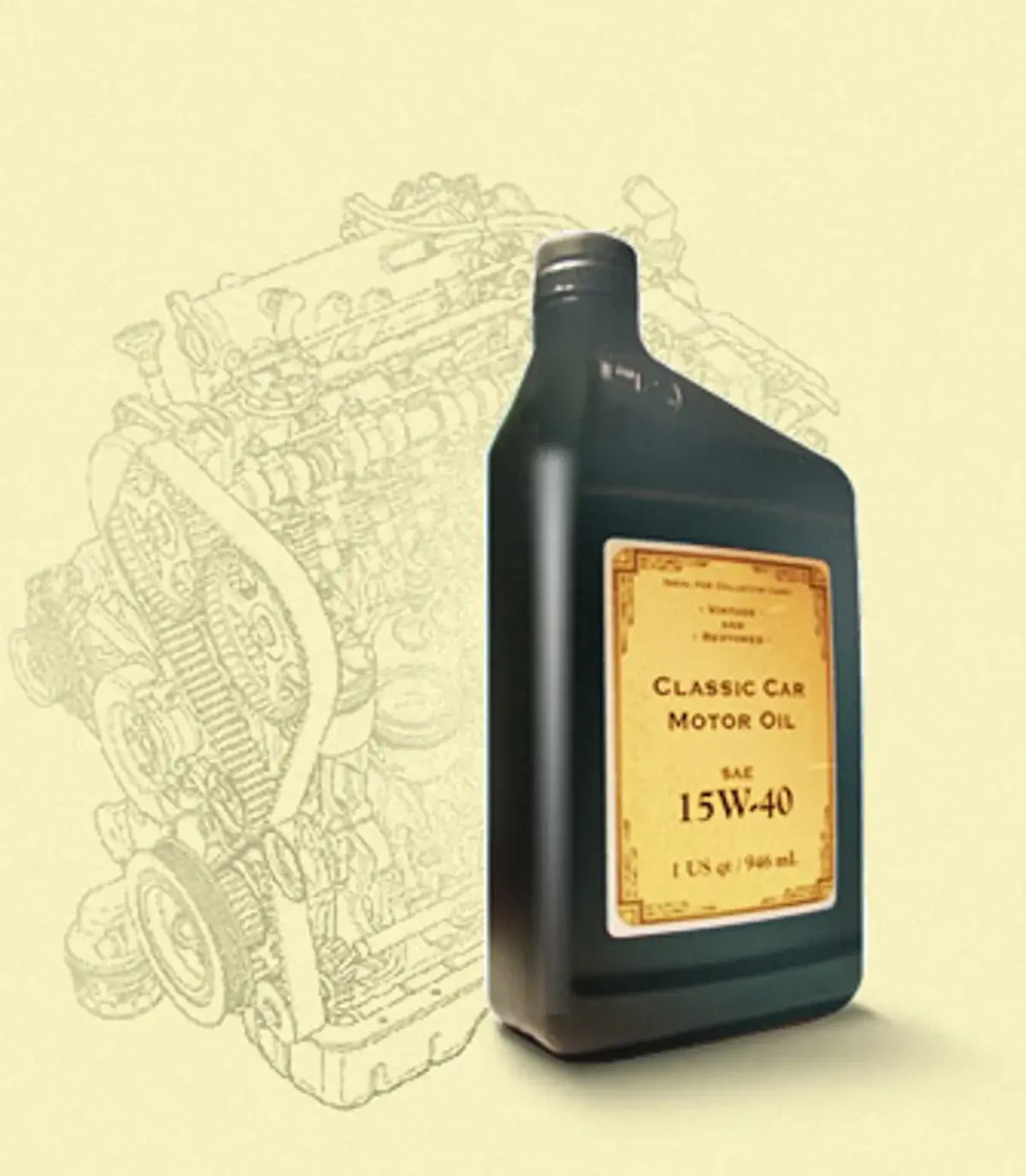
The Indiana Region of the Classic Car Club of America and D-A Lubricant Company, Inc. are proud to present a revolutionary motor oil specifically produced to reduce mechanical wear in your classic car’s engine.
Vintage Engine Oil
Optimal Zinc Levels
Anti-Rust Formulation
Retains Strong Film Thickness with Temperature
Sold only by Indiana Region of the Classic Car Club of America as a National CCCA Project
Our multi-grade oil is thinner at start up allowing the oil to flow rapidly to wear points. Beyond 100 degrees centigrade, the CCMO retains its viscosity better than Mono-Grade oil. CCMO contains high quality viscosity modifiers. Viscosity modifiers keep the oil thicker at high temperatures. Inexpensive and many moderately priced oils do not contain high quality viscosity modifiers. The new SM OIL has viscosity modifiers which degrade. This is not good for collector cars or really any engine.
CCMO has an optimal level of ZDDP, which decreases wear on highly loaded rubbing services. It is most helpful in the cam lifter interface, the piston ring/cylinder interface and any moving part that does not run in a cushion of oil.
Classic Car Motor Oil is sold by the case (12 quarts). The oil can be ordered from our website, https://inrccca.org/product/classic-car-motor-oil/ or by phone at (317) 225-0040. Classic Car Motor Oil can only be purchased through the Indiana Region of the Classic Car Club of America.
Y
Comment on this listing…
Comment
Comments (3)
· 21h
Rachel, the Indiana region was always very active selling worthwhile things. I bought a set of sidemount covers for my MB 25 years ago. I wish you still made them.
Do you know the history of the oil? How long you guys have been selling it and when it started? Would be interesting to me.
· 19h
Glad you asked AJ - Classic Car Motor Oil (CCMO) came to the aid of vintage engines in 2007 as a collaboration between the DA Lubricant Company of Indiana and the Indiana Region of the Classic Car Club of America (CCCA). It has the imprimatur of the CCCA. There began to be some camshaft failures in the mid-1990s when API-SJ oil came out in 1997 with about 1090 ppm zinc (mostly ZDDP). The preceding oil was API-SH with about 1300 ppm zinc in 1994. It takes around 1200 or more ppm zinc to protect the camshaft in break-in of flat tappet engines. The camshaft failure problem became epidemic when API-SM oil came out in 2004 with about 870 ppm zinc. There was little warning of the remarkable diminution of zinc over time. Zinc ppm in the 1980s was over 1600 ppm. You can read all about it on the Indiana Region website ( hear about the project in Dr. Klein's own words -