RO
@Robert A. Borman
Stutz made a Blackhawk model and also made a Black Hawk car. The second was a cheaper companion car with a flathead engine.1929 and 1930 would be about right.
Look in the interchange possibilities. I suspect the car had a Stutz chassis with bought in engine but don't know the details. It would be interesting to know what parts they used.
In the interchange book the Blackhawk is one word in the listting. I have other books, and this is the same. If your info is corect in that they had a flathead engine, I could see that working for me in locating parts. They may (Stutz) have used the Continental Motors, motor in that Blackhawk then. This was and is a very good motor. So they may have just used one of them. Anyone have any History on this car?? The Blackhawk the cheaper one???
Hi,
I have a little information on the Blackhawk automobile on my website. Check out the link below to access a pdf file. Blackhawk made an eight and a six cylinder auto in several models. There are no pics just info. It's on three or four pages just scroll down to the correct listing. It's a scanned spec section from a 1929 Motor Magazine.
http://www.nucwa.com/nov29spec.pdf
GaryB
From the <span style="font-style: italic">Standard Catalog of American Cars, 1805-1942</span>;
"The Blackhawk was a less powerful, less expensive and less noteworthy car manufactured by the Stutz Motor Company of America," produced in 1929 (1310 made) and 1930 (280 made).
Not to be confused with "the fabled Stutz Black Hawk (two words) speedsters"...
TG
I had it backwards, the Black Hawk was a Stutz sport model with a boat tail body. The Blackhawk was the lower priced companion car, made by Stutz, with a flathead engine.
The Stutz cars from 1926 up had an overhead cam straight eight.
Before 26 they had an OHV 6 and way back they used a T head Wisconsin engine.
This is all from memory so don't bet the farm on it LOL.
The Blackhawk L6 and L8 were concurrent. If you were given the opportunity to test drive both with identical body type so you could choose which to buy new, you would almost certainly choose the L8 with the side valve, Rickardo head Continental enine, which had a couple more bhp from the same displacement. The 6 cyl version of the OHC Stutz 8 had a less efficient "tuna tin"combustion chamber, and would probably be more thirsty. Carburettor was identical diecast dual thrat Zenith 105DC, but with slightly different jet and venturi sizes. (I have made new bronze replica carbs for one of each).
The chassis was similar in style to the contemporary M series Stutz 8cyl, but a few inches shorter. They used the same four speed gear box with a curious device on the back to prevent the car from rolling backwards except when reverse was selected. The chassis of the Blackhawk was used for some special racing jobs for LeMans, fitted with the 8 cyl OHC engine but without the hill-holder on the gearbox because you would have to cut and alter the X brace crossmember of the chassis to make room for it.
Maybe the cars with the Continental were usefully cheaper to produce, yet sold at the same price; so it might have been inspired marketing if it had not happened when the market for cars was about to shrink so dramatically.
The engine that was perhaps more predictive of a modern engine was the prototype DV24. One still exists. Those Stutz engines were very heavy,and a fair bit of that comes from the extra engine height of long stroke and long conrods. Imagine a developement of the pent-roof 4 valve/cyl DV24 of about the same displacement, but over-square bore/stroke ratio, with good overlap of bigend and main bearing journals giving better torsional rigidity, bigger valves, and much lighter block and head through modern thin-wall casting capability, and the design would have been good for another 70 years.
Ivan Saxton
The DV24 sounds like the postwar Jaguar six.
Unfortunately car design was taking a different direction at the time. The Stutz was an outstanding car but it was not the type of car people were buying in the mid 30s.
10 to 20 years later speed, sport and performance sold cars. But by then it was too late for Stutz.
This is a 1929 Blackhawk L6 4-passenger Speedster by Lebaron, taken at a
Connecticut show in 2007. I should have jotted down a few notes and
taken more pix, like a closeup of its unique sundial radiator cap.
Next time, for sure.


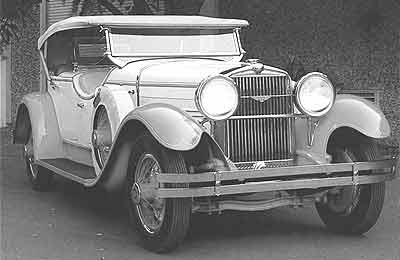
A 4-passenger Tonneau Cowl version in an earlier, undated photo from the LeBaron, Inc. entry at www.coachbuilt.com
Note the different contours of front & rear fenders between the middle and bottom pix.
Detail from the 2007 Glenmoor Gathering, more photos here...
http://www.flickr.com/photos/8512105@N02/1403894947/in/set-72157602064588970/
TG

http://photos.aaca.org/data/500/Stutz_Motor_Jan_29_1X.jpg Larger, click once after opening.
The intro of the Blackhawk from <span style="font-style: italic">MoToR</span>'s Annual Show Number, January, 1929.
You'll find 3 more pages of good reading in the Photo Gallery above.

http://photos.aaca.org/data/500/Blackhawk_Motor_Jan_29.jpg
This ad was elsewhere in <span style="font-style: italic">MoToR</span>'s Show Number, facing a similar Stutz ad,
which is in the Photo Gallery, too.

This more colorful detail of the Blackhawk appeared in the <span style="font-style: italic">SatEvePost</span>, January 5, 1929,
with the same text and layout as the <span style="font-style: italic">MoToR</span> ad above.

This Stutz flanked the <span style="font-style: italic">SatEvePost</span> ad above, I just couldn't get the whole page scanned.
You'll find bigger files of these details in the Gallery, too.
I found the <span style="font-style: italic">MoToR</span> info paging through my dog-eared Show Number copy, and the <span style="font-style: italic">
SatEvePost</span> ads have been kicking around in an album for years;
hope you enjoy them.
TG
Something looks oddly funny about how the rear wheels/fenders look on that tan car. The rear wheels are pushed out way too far.
I know the owner of that car, he's a very technically minded person and owns a bunch of Stutzes. I think it's an optical illusion. I know that car still has the correct worm drive rear end under it. If you were at Glenmoor in 2007 you saw it in person.
To join in the conversation, you must be a club member.
You’re welcome to read and like every post. Members can reply and start topics of their own.

