19
@1935Packard
A 95 point car is a very nice driver to me. 1st place is sometimes a matter of who is in the class. These days more than 50% of the cars at a Grand Classic are retired to exhibition. There might be 2 or 3 cars in the class.
Thanks, AJ. Maybe this is a dumb question, but do they give a "1st" to whatever car comes in highest in that class, no matter what point level that is?
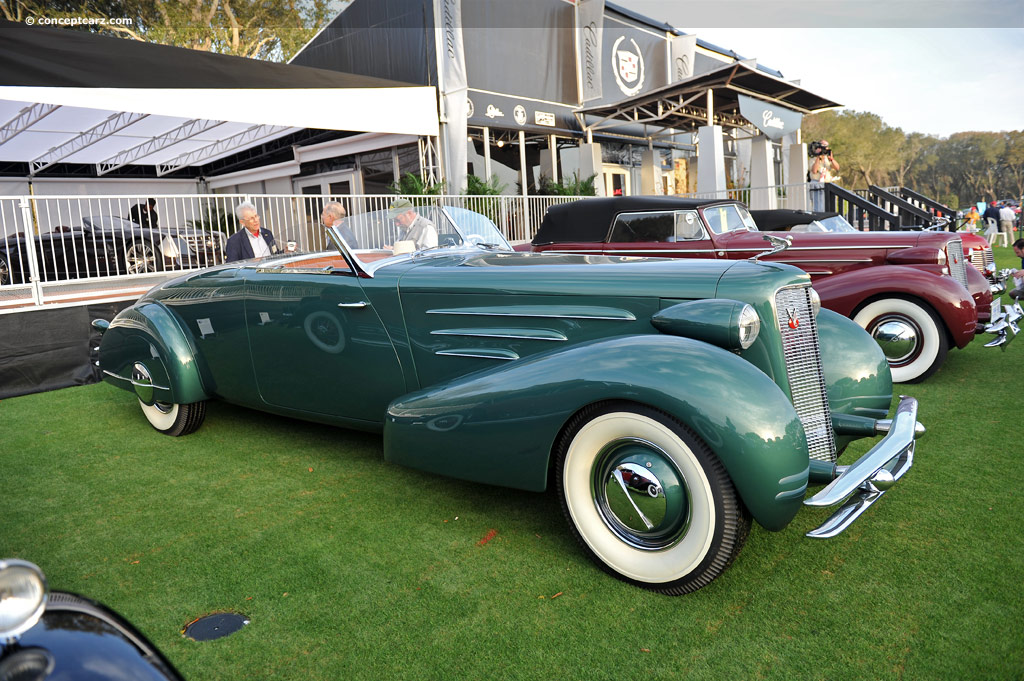
While I'm on the topic, I've also noticed some cars are judged in the category of "customs" when they are not what I would consider customs. For example, that Cadillac was apparently judged as a custom because it was bodied by Fleetwood. And I have seen '35-'36 Packard senior open cars judged as customs just because the bodies, although the standard open bodies, were given a Dietrich badge . Not sure if that is common or rare, but it seemed a little odd to me.
[ETA: I fiddled with this to be more accurate about the Dietrich point; thanks to West for pointing out my sloppiness.]
There's a new head judge in the CCCA; he's a smart guy and a very experienced person within the hobby. He is proposing some judging changes that will both streamline the process (there are something like 70 line items on the current judging form) and hopefully improve the quality of the judging, which I think is a problem as it stands today. It's what I call "trophy creep," which is a way of saying that there are an awful lot of high-point cars running around with big awards that maybe they don't deserve. All clubs are full of buddies who don't want to go too hard on their friends' cars, or judges are inexperienced, or there's simply not enough time to properly judge a car (I'm always the last guy because I take my time and I frequently feel pressured to rush through it). Regardless of the reason, the CCCA is cranking out a stunning number of very high-point awards and an even more stupendous number of 100-point cars. To me, 100 points is an unachievable number, yet every issue of the "Classic Car" is full of 100-point Classics, sometimes multiple pages of them. I personally find it hard to reconcile the quality of, say, Judge Cassini's Pebble Beach-winning 1934 Packard Twelve Victoria, which I judged at the Annual Meeting last year, and the 1941 Packard at the Ohio Grand Classic in August, both of which scored 100 points. I know for a fact that the 1941 Packard has at least ten thousand tour miles on it. They cannot both be 100 point cars. They may both be first place cars, depending on what else was in the class, but 100-point perfection is a worthy goal that is not, in my opinion, achievable.
To be honest, I disregard most awards aside from marque club awards (sorry, AACA, that includes you), simply because they're beauty contests, not arbiters of accuracy, and even at that, most judging is a rush job simply due to the volume of cars. Worse yet, I think there's a lot of pressure on judges to deliver high scores so that all the club members can have a good feeling about an event. I specifically recall five or six years ago, going to my first Grand Classic with my 1929 Cadillac and the organizers asked me if I was having it judged. Being someone who doesn't really care about trophies, I said, "No, I don't want to waste the judges' time, I know it's an 85-point car." Their reply? "Don't worry, we'll make sure you win." Well screw that, I really don't want to win now. Even with "impartial" strangers judging my car today, I bet I could get more than 95 points and a first place at a Grand Classic with a modicum of minor touch-up.
I am probably digging my own grave here because my name is on this post and other club members will see it. Once you're known as a tough judge, life changes within the club and my reputation will probably be injured. I don't particularly care, because I think integrity matters and it does a disservice to the club, the cars, the owners, and the restorers to hand out big awards like candy, but that's apparently the way most folks like it. I'm hoping that the new head judge feels the same way. To me, it's embarrassing that one recent Grand Classic had 22 out of 69 cars score 100 points. That's not indicative of the quality of the cars, it's indicative of the quality of the judging and the club itself.
All that said, the Cadillac in question is a nice car. It's owned by my former business partner and I've seen the car in person on several occasions. It's quite nice and well-sorted, although I believe it's a V8 car ordered on the longer 12-cylinder chassis, so it's a big car with less power. I don't think the body has ever been off the frame, so it's scruffy underneath. However, I also think it's priced appropriately for what it is. It also very clearly illustrates the fact that CCCA judges are not willing to soil their trousers by kneeling on the ground to look under a car and often don't have the time to do so anyway.
I'm not criticizing the clubs or judges specifically, I just that I think things should be tightened up and held to a higher standard. I think the new head judge feels the same and changes are coming that will help. I hate that I have to keep my head down because I care about quality and integrity. I'm glad I'm not alone and hopefully revisions will make the awards that much more prestigious.
Thanks, Matt! This is an awesome comment, as your comments often are.
One of the cars I recently inspected in person was a car that won a bunch of CCCA awards when it was owned by the then-director of the local CCCA chapter. I was expecting it to be a fantastic car based on the CCCA awards and point totals, and I was really disappointed when I saw it in person. It was a good driver with excellent chrome, and it had had a lot of recent work by a very good shop. But it wasn't a show car. Without knowing much about CCCA judging, I confess your statement that "clubs are full of buddies who don't want to go too hard on their friends' cars" came to mind.
#1 Matt is correct.
#2 Matt is correct.
#3 Matt is correct.
See my PM sent to you. Ed
Did I say Matt's post was correct?
I was a CCCA judge in the 1980's. I was very tough on cars, as I knew what a good car was, and I knew what a great car was, and I knew when a car was as close to perfection as humanly possible (which, to me, is a 100 point car, everything is exceptional).
I saw the results of very well to do people getting very mad about judging, and at that point I pretty much gave up judging and worrying about any trophy whatsoever. I have one trophy that I received in the '80's, a first place for my '38 Packard 1604 convertible coupe from the CCCA, and that is the extent of my trophy room.
"Good Old Boy" judging has been around forever. I once bought a 1909 Sears Autobuggy from a Mr. Stewart in Longview, Texas. It was a fantastic restoration, done by him, and mechanically was just as correct, two pulls with switch off and choke on, one pull with switch on, started every time. Mr. Stewart bought a 1911 Buick, if I remember correctly, a nice little car but he didn't restore, and it showed that it was an older restoration and a little ragged around the edges. We both showed up at Petit Jean mountain one year, being judged in the same class. At the time, the judging consisted of drive your car in front of the bleachers, 3 or 4 judges walked around your car, and that was it. When the result were tabulated, "Good Old Boy" Stewart (everyone knew him well, didn't know me at all) took 1st with the Buick, and I took 2nd with the Sears. Mr. Stewart looked like he'd been slapped in the face, they didn't appreciate HIS restoration of the Sears, and he let them know it! I didn't care, but I bet it's one of the few times that a first place winner has complained about winning!!
Matt, your posts are always well worded and very worthwhile, I think you out did yourself on this one - please keep making your excellent comments. Never heard the expression "trophy creep" before but it is priceless and one I will remember.
Speaking of judging, I just saw that a car I know well and have driven on several occasions got an HPOF award. It's a great car but as the owner freely states, it is a made up car. It does preserve original features but they are either from various cars or fabricated.
Another thing you have to look at is how long ago it won the senior award. A lot of people restore their cars, run them through the judging ranks for a couple years, and after they get their senior badge they start driving them on tours. The restoration on the car then starts to deteriorate, especially in the engine compartment and chassis area. A 100 point car that has been driven 10,000 miles might look like a 93 point car now. There's nothing wrong with this, as that's what I plan to do with my cars when I restore them down the road.
There are a lot of "made up" cars out there, including some early, high dollar, cars. I once pointed out a specific race car, that was being auctioned, that started out as parts of an engine and a dream, and was a total fabrication, but that was not acceptable to AACA powers that be. That's fine....
But be aware that there are cars that look totally original, may even be weathered and such, but are works of art, as little is of an original car......but of course I won't name names nor identify a particular vehicle....but they're out there.
Really nothing seriously wrong with this, unless car is marketed as original for high dollars....
Some of the best fiction on wheels ever built........Packard open cars. I regularly see rebodied stuff getting passed off as original. Any person buying a CCCA open car should hire the best people in the hobby they can find, it will save hundreds of thousands of dollars. As a Pierce Arrow guy, I can say there are currently six "fake,made up,repowered,or cut down" cars that have been on the market in the last ten years. Actually the time frame is MUCH shorter, I just don't need he hassle of phone calls or lawsuits. Buyer beware on all open cars of every era.
Yes Ed, I remember years ago a certain operation in NE Pennsylvania that turned out some great looking Packard DC phaetons that had been converted. There were even some 734 speedsters created as I recall. West is one who knows which ones are real.
David mentions high value early cars and I can name several well known ones that don't even have the correct or original engines. Heck, Carl Amsley turned out dozens of Stanleys and was able to use correct chassis numbers from cars that no longer existed. Similar work is being done now by someone who recently told me that his cars are more accurately recreated than the ones done by Amsley.
Many people say it's fine to recreate famous racecars and other outstanding vehicles that once existed which is fine until years later they are claimed to be authentic.
I don't mind a recreated car, or one that replicates a car lost to time. The problem is, as generations pass on and cars are handed down or sold, the fabrication becomes reality.
Many people in the know understand and recognize these cars, but 50 years from now, when these people are memories, then there'll be hell to pay authenticating original versus built cars.
trimacarOct 21, 2016I don't mind a recreated car, or one that replicates a car lost to time. The problem is, as generations pass on and cars are handed down or sold, the fabrication becomes reality.
Many people in the know understand and recognize these cars, but 50 years from now, when these people are memories, then there'll be hell to pay authenticating original versus built cars.
Let's do an intellectual exercise. The question that really blows my mind regarding re-creations/rebodies/fabrications/assembled cars is: Why does it matter?
Why is the matching-numbers 1969 Camaro worth more than an identical 1969 Camaro with a different set of numbers stamped on its block? They look the same, drive the same, sound the same, use the same parts, and deliver the same experience. If you didn't know it wasn't matching-numbers, you wouldn't know from looking at it or driving it.
There was a Duesenberg J dual cowl phaeton sold recently that used a reproduction frame, the bellhousing and engine from two separate (but real) Js, and a reproduction dual cowl body. Same experience, same look, same performance, 25% of the value. I would gladly own and drive that car.
I understand about race cars that have a different kind of history, but in terms of fakes/clones/rebodies, if the experience, the look, the hardware is all the same, why wouldn't you want to own it and why is it worth less than a "real" one (other than the "it's just worth more because it's real" argument, which is based on the same basic idea our currency system is: everyone believes that little piece of paper is worth the equivalent of $100 worth of goods, therefore it is. But if nobody believed...?)?
I'm just curious because it's so hard to articulate why authentic/matching-numbers cars are worth more. The only reason most people can come up with is, "Because they're more real." That's not really a reason if you think about it. Thoughts?
Matt, I'll bite. I think it matters what is real and what is fake for the same reason it matters in the art market. A real Mark Rothko painting might be worth $5 million, and a fake Mark Rothko painting might be worth $5,000. They look the same, and they don't "do" anything beyond how they look, but the difference in value might be a factor of 1,000 to 1. The difference is that one is a historically significant object and the other is a canvas with some paint on it. When it comes to historically significant objects, history is important; the value is not just in the experience of looking at it, or looking and driving it, but the fact that it is something associated with a particular time that had meaning in that context. It's not historically significant if it's a modern reproduction of something historically significant. My 2 cents, at least.
I thought of the art angle too, but to me, the important thing about art isn't the result, it's the process. The artist touched that paint, applied it with his own hands, and created something that only he could see and shared it with us. It's the creation that matters. To paraphrase Michelangelo: the statue is already in the stone, I only have to remove the stone that doesn't belong. But only he had the ability to see the images that were the result of his work. I certainly agree with what you've said, and that's surely why art is significant in many ways and probably also with cars, but it's still an abstraction. They're machines. They're beautiful, wonderful, emotional things, but they're mere machines. They weren't built by artists (please, let's not argue the point, you know what I mean) and the process of building them isn't necessarily integral to their value.
Isn't "historically significant" pretty much the same as "it's more valuable because we believe it's more valuable?" The Declaration of Independence is historically significant. But unless it's JFK's limousine or the Bonnie and Clyde death car or something otherwise historical is attached to a car, history isn't the determining factor in its worth. Merely existing for decades does not history make.
Is something as simple as age a factor? I don't know. That's why this question vexes me so much.
1935PackardOct 21, 2016something associated with a particular time that had meaning in that context.
This is closer to the idea. I like this. But does it address something like this 1934 V16 Cadillac that never existed outside of a Fleetwood catalog? Why is this car not worth as much as if it had been built in 1934 instead of 1998? It's no less "real" and still represents the time period in which it was conceived.
CCCA JUDGING STANDARDS - AN EXPLANATION
I appreciate why some of you guys are confused with CCCA judging results.!
At a public car show, where folks may spend a LOT of money just to get in and look around, they have a RIGHT to be entertained - thus you will see brightly colored cars (that may or may not be safe or even capable to drive on a public street - can often be little more than costume jewelry) Competition between cars is part of the entertainment, with people rooting for their favorites. So of course they have "first place" trophies.
Classic Car Club Of America judging events may or not be publically attended. Remember, for many years after our formation, the whole idea of saving the largest, most powerful, most elegant luxury cars of the late 1920's thru 1942 was considered nuts or worse by the general public! Pleasing a viewing public is irrelevant to a CCCA event; something that would not have occurred to us in our early years as a car club when our Judging Rules were formed.
At Classic Car Club Of America events, our tradition is quite different - our cars are not in competition with each other - our cars only compete against what that particular car was like when first placed in use by the original owner. That's whole purpose of the CCCA - to try and preserve the history & technology of the classic car.
So - our judging standards do not require perfection to receive 100 points. We instruct our judges specifically (and I quote our Judging Rules) KEEP IN MIND THESE CARS WERE BUILT TO BE USED, AND THE MERE FACT OF SIGNS OF USEAGE SHOULD NOT IN ITSELF CAUSE HARDSHIP IN JUDGING !
Thus at our judging meets, all the cars present may get 100 points, some of them..or none of them - depending how many of them represent their condition when delivered as a new car. No reason why a plain black sedan with black-wall tires should get any less points than a spectacularly colored open car - again..assuming both most closely represent their respective condition as new cars.
When new, they had grease on their fittings, and while their fit and finish was exception, it certainly wasn't "costume jewelry perfect". We check for working safety features like lights, windshield wipers & horns. Under our "authenticity" I was frankly disappointed when we changed our rules to allow "over-chroming" without deduction - since so many of the most elegant luxury cars of that era had more subtle nickel-plated interior hardware, that restorers may now re-chrome.
Bottom line - yes - the judging results at a Classic Car Club Of America function may be confusing to those who are accustomed to the fancy public cars shows. That is the way it should be.
"Signs of use" and "built to be used" are two very different things. When a car that has been driven scores 100 points and a fresh (over-) restoration also scores 100 points, there's a problem with the judging. I don't deduct or add points for style, color, or "flashiness" but I do expect a car to be as close to new as possible if they want to get all the points. I don't like over-restoration, but it's unavoidable anymore. So if you want 100 points, you'd better nail it and it better be unused, as-new condition. A car that has been driven any significant distance just can't be 100 points, and certainly not one that has been driven thousands of miles. Yet it happens with sickening frequency.
I don't think the founders of the CCCA would appreciate all the 100-point scores being handed out today any more than I do. It's supposed to reward effort, preservation, and achievement. Instead it appears to merely reward participation.
Now I'm going to irk one of our forum semi-frequent fliers. At a recent CCCA Grand Classic in the middle part of the country, a mid-1920s Pierce roadster achieved 99.75 points (no, I wasn't there, nor have I seen the car but have seen photos in the for-sale listing), but the car had (1) a 1948-vintage (per the owner) replacement canvas top and (2) a conversion to down-draft carburetion with what appears to be a forklift air filter. Despite the repaint, replating, and re-upholstery, those modifications/condition aspects would have resulted in less than 90 points at a PAS Meet.
One need not be a Pierce marque expert to see that these aspects warrant more than an 0.25-point deduction from "when delivered as a new car." Can you enlighten us, Mr. Shiny Hubcap?
Matt HarwoodOct 21, 2016I thought of the art angle too, but to me, the important thing about art isn't the result, it's the process. The artist touched that paint, applied it with his own hands, and created something that only he could see and shared it with us. It's the creation that matters. To paraphrase Michelangelo: the statue is already in the stone, I only have to remove the stone that doesn't belong. But only he had the ability to see the images that were the result of his work. I certainly agree with what you've said, and that's surely why art is significant in many ways and probably also with cars, but it's still an abstraction. They're machines. They're beautiful, wonderful, emotional things, but they're mere machines. They weren't built by artists (please, let's not argue the point, you know what I mean) and the process of building them isn't necessarily integral to their value.
Isn't "historically significant" pretty much the same as "it's more valuable because we believe it's more valuable?" The Declaration of Independence is historically significant. But unless it's JFK's limousine or the Bonnie and Clyde death car or something otherwise historical is attached to a car, history isn't the determining factor in its worth. Merely existing for decades does not history make.
Is something as simple as age a factor? I don't know. That's why this question vexes me so much.
This is closer to the idea. I like this. But does it address something like this 1934 V16 Cadillac that never existed outside of a Fleetwood catalog? Why is this car not worth as much as if it had been built in 1934 instead of 1998? It's no less "real" and still represents the time period in which it was conceived.
Matt, I'll stick with the art analogy and say that it's the process of building the car that matters, too. One man's Picasso spending days painting that exact painting is another man's Duesenberg being built and assembled by Duesenberg exactly like it is. As for the '34 V16, it's not worth as much because Cadillac didn't actually build it then. In the painting example, you can't take a Picasso, cut it in half, and sell each half as Picasso paintings. Well, you can, but they'll be worth a small fraction of what the original was worth. Picasso's involvement hasn't changed, but it's no longer exactly what Picasso painted. My 2 cents, at least.
[ETA: I realize that at bottom the market values what the market values; in both classic cars and art, these are luxury goods only worth what people pay for them. I'm instead offering what I take to be the thinking behind the relative valuation of the 'real' and the 'fake.']
I believe the value of an original car is that it has the history, it has a story, it existed during the period of time it represents. We may not know the story, but it was there in that moment of time.
A recreation, a replicated, a built car, does NOT have a story that is historically of interest. Yes, it may drive and appear the same as an actual vehicle that would have been made at that time, but it has no essence, no soul if you will (and I'm in no way equating a piece of metal and leather with a human).
Serious collectors of historical artifacts (including cars) may appreciate the copy, but they want to own the original. Another analogy is a jazz recording by Satchmo, the famous trumpeter Louis Armstrong; there are people who can play the same notes today, but his rendition is the one you want to listen to.....
I recently questioned a friend of mine about an early Pierce Arrow project, one at the limits of what I could afford, but there are always methods to get money when cars are involved....I was told by my expert friend not to go with a project that had numerous newly made parts, for a high dollar car, as the worth is just not there compared to, OK, let's call it a "real" car. I understand this....
As far as judging goes, I have no issue with the methodology of judging of the CCCA, it's the childish reactions of grown men who have "lost" or received a lower award than they expected that has turned me off of having a car judged at all.....I've seen a man, who didn't win a best of show award, slap the banquet table with his hand, curse the associated club, and swear he was going to sell the car (a fresh high dollar restoration), which he did....not the reaction of someone who really appreciates early cars....
trimacarOct 21, 2016A recreation, a replicated, a built car, does NOT have a story that is historically of interest. Yes, it may drive and appear the same as an actual vehicle that would have been made at that time, but it has no essence, no soul if you will (and I'm in no way equating a piece of metal and leather with a human).
This is a good explanation. The easiest way to look at it to me is thinking of the Mona Lisa and a perfect copy of the Mona Lisa. They look identical but a collector of any stripe knows they are not the same.
Put it another way, I have a choice of two cars that look almost identical. One has paperwork, an ownership history back to new, etc while the second car doesn't. I would naturally pay more for the first car with history. Now, add in the fact that the second car was actually reproduced in the not distant past. The price spread is even more in my mind. Enough guys thinking like that is what sets the market.
1935PackardOct 20, 2016I have recently looked at cars -- in person, and on the web -- that won recent CCCA 1st prizes but appeared to be what I would think of as #3 drivers. I'm curious if that is common or rare.
For example, this car for sale won a 1st at the 2016 Ohio CCCA grand classic. And yet if look at the pictures, it looks at least to me like a driver. (The online advertisement says that it won 98 points, but the Fall 2016 Classic Car suggests at page 47 that it was judged at 95.75 points in the "Custom 1937-39" category -- either way, it was given a "1st.")
I judged at that Grand Classic. I can say with certainty that in my class there were a few "less than 90-point" cars that received close to 100 points. I couldn't have been more disappointed in my fellow judges. It only hurts CCCA (or any other club that does this for that matter), as it proves it's judging system is less than good.
ccca
CCCA JUDGING DISCUSSION cont:
Please - PLEASE guys - do not take this as a personal attack. Your mis-understanding of what the CCCA and its judging rules are all about, is today quite normal and common. As you guys correctly point out, there have been, on occasion, some rather theatrical examples of error.
As I noted, our CCCA judging rules were designed for an entirely different purpose than what happens at the typical modern car show.
First of all, with few minor changes, our Judging Rules have not changed very much since we solidified them in the mid 1950's. ( I have an unfair advantage over some of you...I personally don't have to guess at what our founders had in mind .....! )
Here's one example of how we pretty much eliminated personality issues from our scoring. (many modern car shows have copied some of our rules for that reason). Each judging team has FOUR judges. The highest and lowest scores are DISCARDED - only the remaining two judge's scores are then "averaged" for a final score from that judging team.
Hopefully, neither Mr. Harwood, Mr. Petersen, nor others In here will take offense if I use portions of their posts as an example of how different we are in the CCCA. Harwood states " SIGNS OF USE AND BUILT TO BE USED ARE TWO VERY DIFFERENT THINGS. WHEN A CAR THAT HAS BEEN DRIVEN SCORES 100 POINTS AND A FRESH RESTORATION ALSO SCORES 100 POINTS THERE IS A PROBLEM WITH THE JUDGING.
Outstanding examples of a breakdown in our proceedures. Failure to understand and/or follow very specific CCCA judging rules. At our Judge's Meetings, the Head Judge is REQUIRED to make it abundantly clear how different CCCA judging rules are from the typical "car show". Let me quote what the instructions that SHOULD have been made clear to Mr. Harwood and Mr. Petersen at their Judge's Meeting(s. Incidentally, these instructions have remained pretty much unchanged since these rules were codified back in the late 1950's. So - what failed here; a Head Judge failed to properly explain to Mr. Harwood's & Mr. Peterson's judging teams what we are all about, or did they confuse CCCA with their other car clubs?
Let me repeat what instruction they should have...were REQUIRED to recive........"IN JUDGING, KEEP IN MIND THESE CARS WERE BUILT TO BE USED, AND THE MERE FACT OF SIGNS OF USE SHOULD NOT IN ITSELF CAUSE HARDWHIP ON THE OWNER WHEN JUDGING."
Yes, of course we've made minor changes over the years ( some of which I personally opposed...others...I wrote...!).
We no longer deduct for non-authentic paint, and we no longer deduct for 'over-chroming". ( many of our big-engine super luxury cars from the 1920's and 1930's had nickel-plated interior and engine fittings, as it was in that era considered more tasteful than chrome). We now require you to demonstrate that internal mechanicms like windows are functional.
The post by 1935 regarding re-bodied/ "phony" cars has given us trouble in the past. It has long since been resolved. Again, a quote from our rules " NEW COACHWORK - ALTERED IS A NON COMPETING DIVISION". Yes, if you obtain PRIOR PERMISSION from "National", then and only then can you DISPLAY such vehicles at a CCCA event.
Yes, I am glad to see that TRIM has "no issue" with CCCA judging. Glad to learn he "gets it". As for the rest of you, a better understanding of what the CCCA is all about, how down thru the years we have become to appear "different" from the typical public car show...would reduce some of your concerns.
I was born into the hobby, specifically CCCA, and have judged in CCCA since the 1970s. I "know" what it's about. I stand by my statement that I couldn't have been more disappointed in my judging team that day (I was lead judge). Even the car owner(s) were very surprised at the results. I repeat: it does the club no good for an 85-point car to wear a CCCA Senior badge. It certainly lessens the meaning for the car owner who actually deserved the Senior badge. There is a huge difference between "signs of usage" and obvious poor restoration work.
Interesting discussion, many good points being taken, but I do feel CCCA had taken a bad rap for some past decisions, and are still being held accountable for those. Like any club CCCA is a work in progress, all areas are evolving - my opinion based on first hand experience since being elected to the National Board almost 2 years ago. If you sit at a national board meeting for 7 to 8 hours straight over a period of meetings over the years you get to know the people fairly well. There are a lot of hard working board members there (as there are on any club be it multi marque or specific make) As Matt mentioned there is a new Head Judge , reread Matt's comments about him - totally correct, I agree completely. The man also has a substantial collection of original unrestored cars, that he drives! I don't judge, not my interest, but my sincere interest is in accurate historical information, authenticity , and the research and writing about same to share with others. I gave a talk on coachwork at the last CCCA annual meeting in Detroit, and may possibly give one on the topic of authenticity at the next one in Reno, Nevada , all the material and images used to illustrate the talk will be period material that I will resource from my archives .
West PetersonOct 21, 2016I repeat: it does the club no good for an 85-point car to wear a CCCA Senior badge.
Well, very interesting comment, and if that is happening, then it's a shame. I've not judged CCCA since the early 90's, so haven't kept up with rules nor real life application of those rules.
It could also be a potential financial disaster for a buyer, if he depends on the judging results to justify paying a certain price for a Classic, as I did once.
In the mid 1980's, I called a gentleman about a trunk he had advertised for a 1938 Senior Packard. At the time I had a 1603 sedan, and thought maybe a trunk would work on it (now, no, don't think so). While discussing the trunk, the gentleman mentioned "Yes, I'm selling the car it was to go on, so that's why the trunk's for sale". Umm, what's the car, might I ask. "1938 Packard 1604 Super Eight convertible coupe", he replied. Ummmmmm, what's the condition of the car? "Senior CCCA car, scored 99 plus points a couple of years back...". Ummm, OK, what do you want for car. He told me. Well under market. Told him I'd call him back. My next call was to CCCA office, to confirm the award. Yes, they verified the car had won, with close to 100 points. Called the fellow right back, sight unseen, bought the car.
Thus, I trusted the CCCA, and at the time the information was correct and allowed me to purchase the car (which I still have) just days before it was advertised in Hemmings. If the judging of the CCCA can't be trusted to verify true condition, then there might be a fly in the ointment.
As a side note, I sent a deposit to the gentleman on the Packard. A week later, he called me, and asked me if I wanted to make $10K. Huh? Remember, in the mid '80's, $10K was a pretty hefty sum. He said he had a gentleman in his living room, who'd seen the ad in Hemmings and just showed up at his door, and the fellow was willing to pay me $10K to walk away from the deal I'd made on the car. I told the seller no, I wanted the car, not the money. "David," he said, "I'm so happy to hear you say that!". I later asked him why the low asking price on the car when I bought it, apparently a fellow had traded five Classic cars to a then well known dealer for a V-16 Cadillac, the seller was good friends with the dealer, and as the cars were being unloaded, asked for a price on the Packard and was given a low one...thus the car lost "value" in a trade, and I was lucky enough to be in on the deal at a later date....
Car on far left in the picture...still have the 1910 Hupmobile (now restored to correct colors), the Mercedes is back in it's homeland, the '66 GT-K Mustang (with factory automatic) lives in the mid-west.....

trimacarOct 21, 2016I don't mind a recreated car, or one that replicates a car lost to time. ..
I don't "mind a re-created car" either. ... BUT....I am not clear why you guys persist in discussing this and other issues typical of the arguments, issues, etc. that can be expected at the public car shows. These should be impossible at properly managed CCCA judging events.
For example, "re-created" cars are unrelated to what this sub-section and this "thread" are about. It is about the CCCA and our unique place and history. The issue of "re-created/ re-bodied" cars was settled many years ago - they are ineligible to participate in CCCA judging . With this qualification...IF you apply in advance..."National" MAY permit you to bring it to a CCCA judging event and DISPLAY it in a separate non-judging / display only Division.
My apologies for repeating myself - the CCCA - what it is, what it stands for, and how its very clearly stated rules make it quite different from the public car show circuit.
It is a surprise and disappointment to read in here that some of you feel your Judging Team Leaders and Area Head Judges have so completely failed to carry out their duties under CCCA rules.
I am not questioning what some of you who say you are CCCA members have experienced. I do not question the possibility that at some of our smaller, more isolated Regions, either and/or the Area Head Judge, Team Leaders, etc., were not properly educated as to CCCA rules...and/or do not apply them, and/or fail to properly educate the Team Leaders and Judges at their Judge's Meeting.
Is it possible in some of our smaller, more isolated Regions, they cant get four people on a Judging Team properly trained at the Judge's Meeting as to what we do? We have a Vice President Of Regions - I will most certainly bring up your complaints with him at Reno in March.
Again, my apologies to those who do read our Rules - you must be bored with my repeating how our traditional judging rules ( pretty much the same for over 50 years now) pretty much eliminate personality issues. Again...we have FOUR man judging teams. We discard the highest and lowest scores - averaging the remaining two to get the result from that particular Judging Team.
Yes - of course I have personally witnessed owners dissatisfied with their scores at CCCA judging events. The failure is us - we who know what the CCCA is about, but apparently failed to educate some of our members.
Nothing much I could do for the fellow who couldn't start his P-1 because he had no idea how - the puzzled look on his face when I asked him how recently did he actually drive the thing said it all ( I had to start it for him...!). Nothing much I could do for the fellow of a beautifully restored car, who was enraged that we took points off for windshield wipers that didn't work ( I was personally involved - reminded the Team Leader we have an informal tradition - if something dosnt work the owner has five minutes to get it fixed....stuck my nose into the situation (wasn't judging that year) crawled under the dash.....TRIED to keep from giggling when I reported there was nothing I could do...the operating arms for the windshield wipers were "tie-wrapped" in place...no Trico !
I respectfully suggest that the problem here is EDUCATION. We who have some background in the traditions of the CCCA need to work harder to insure our members understand what we are about, and how different we are from the public show circuit, where so many of you apparently have had or heard about unfortunate experiences and are confusing them with us in the CCCA.
Shinyhubcap, as I read the CCCA rules, the prohibition is competing with a car that has a "replica body." The term "replica body" is not defined in the CCCA rules, and I can imagine considerable debate on what it means. For example, does that mean an entirely fake body? If the car was a coupe and it was redone as a convertible, is the body a "replica" or not? And depending on how you interpret that phrase, do you have insight on how the CCCA ban on "replica bodies" was designed to be enforced? Many owners don't know if their cars were rebodied at some point in the past; some may have an idea but may not be sure; others owners might be pretty sure but may not want to bring it up. The rules state that "the Team Leader should go through the list of six automatic disqualification items with the car exhibitor to determine if the car is eligible for judging." Do you have a sense of what specific questions should be asked, what answers should be disqualifying, and how judges might figure out if the answers aren't accurate? Thanks.

1935PackardOct 22, 2016Shinyhubcap, as I read the CCCA rules, the prohibition is competing with a car that has a "replica body." The term "replica body" is not defined in the CCCA rules,
Hi again 1935. I disagree - I am not aware of this as a problem. Our rules are clear.
I recognize that while this particular section is captioned CLASSIC CAR CLUB OF AMERICA, we have contributors who are either not members of our Club, and/or are, but may also, like me, be members of numerous other old vehicle clubs. With so many different clubs advocating so many different policies, judging rules and standards, I appreciate why some folks can get confused.
If you ( & others in here who are puzzled what we are all about ) are not actually a member of the CLASSIC CAR CLUB OF AMERICA let me extend a cordial invitation to join us - google us and request an application - you do NOT need to own a car that conforms to our definition of CLASSIC to be a member. You will receive our publications, including our HANDBOOK , our publication THE CLASSIC CAR, and our BULLETIN. Your questions as to what we are about...why we have such policies, are fully covered. Those of you who are current members and have questions - again, I respectfully suggest you EDUCATE yourselves on what this particular Club is about by reading our publications !
REGARDING YOUR SPECIFIC QUESTION TO ME....AGAIN, I AGREE WITH OUR CLUB'S "ESSENCE."... WE ARE INTERESTED IN PRESERVING ACCURATELY THE HISTORY AND TECHNOLOGY OF THE CLASSIC CAR. TO SUMMARIZE (see Pp. 11 of our current HANDBOOK)
'NEW COACHWORK / ALTERED .....CARS IN THIS GROUP WILL NOT BE ELEGIBLE FOR JUDGING IN
NATIONAL OR REGIONAL EVENTS."
Yes - AGAIN - the Club is aware of the problem you point out (chopping off the roofs of closed cars to make some money by passing them off as legit. open cars). A review of our publications down thru the years confirms the Club does not wish to be a participant in legitimizing such frauds.
Is it possible that some of these replicas have escaped knowledge of our membership ? If they have, and have in fact been participating in our events, I personally would find that extremely distasteful - a violation of what we as CCCA members stand for.
What to do about it ?
If you are a current member, I would certainly bring this up with your Region Director, who, by virtue of that title, is also on the National Board. If you are not - again...a warm and cordial invitation to join us !
1935PackardOct 22, 2016Shinyhubcap, as I read the CCCA rules, the prohibition is competing with a car that has a "replica body." The term "replica body" is not defined in the CCCA rules, and I can imagine considerable debate on what it means. For example, does that mean an entirely fake body? If the car was a coupe and it was redone as a convertible, is the body a "replica" or not? And depending on how you interpret that phrase, do you have insight on how the CCCA ban on "replica bodies" was designed to be enforced? Many owners don't know if their cars were rebodied at some point in the past; some may have an idea but may not be sure; others owners might be pretty sure but may not want to bring it up. The rules state that "the Team Leader should go through the list of six automatic disqualification items with the car exhibitor to determine if the car is eligible for judging." Do you have a sense of what specific questions should be asked, what answers should be disqualifying, and how judges might figure out if the answers aren't accurate? Thanks.
I should apologize for my digression about replica bodies and values and desirability, because I certainly didn't mean to imply that I approved of replicas or thought they were OK for CCCA show fields. I obviously understand HOW the business works as far as replicas and numbers matching and all those esoteric things, but the WHY of it still confounds me. Real cars are always more valuable, that's a given, but the reason behind that reality is less concrete. If you owned a fake Detrich-bodied Packard Twelve and nobody knew it was a fake, would you enjoy it any less?
So please don't take my comments as approval of fake or rebodied cars in the CCCA; I don't think such cars have a place on the CCCA show field and I do think their histories should be revealed when known. This is a discussion about judging and I should have started a separate topic to pursue philosophical esoterica. Sorry!
Matt HarwoodOct 22, 2016If you owned a fake Detrich-bodied Packard Twelve and nobody knew it was a fake, would you enjoy it any less?
Oh yes. First, anybody whose opinion I cared about would know. Second I would feel like a poser in a fiberglass Cobra. Third, it seems dishonest on about 10 levels.
No, what I mean is if you didn't know, nobody knew, nobody could tell, would it matter?
Never mind. I'm somehow not making myself clear. It's an abstraction for me to consider alone. Let's go back to letting Pete Hartmann talk down to us.
The experience of driving a replicated car can be considered the same, Matt, as you're behind the wheel of a machine that could have or did exist at one time, and it gives the feeling of being back in time.
The pride of ownership would be different, however, between a replicated car and a documented car, whether it be a coach built car or an original.
There's nothing wrong with any of the replication going on, UNLESS someone tries to sell it as an original. There was an early race car for sale at one time, I know for a fact it was made up of a correct period engine and a lot of imagination and fabrication. Would it be fun to flog around a track? Absolutely! Is it a real historical object that one could have pride in, and feel they were touching another time period when owning it and being around it? No, not really, it's mostly new....
The "Darrin" speedster thread is a classic example. Dick Saunders built that car in the 1940s, took pictures of building it from an Auburn, there are copies of the serial number in period showing the car he built it from matching the current "Darrin" speedster and the body is clearly Auburn. For years this was pawned off as a coachbuilt car and to this day there are guys arguing that it is real.
Shiny/Peter, I've been a CCCA member for 9 years, have a CCCA car, had it judged at Grand Classics, etc. I'm just suggesting that the underenforcement of the CCCA's standards may result from the drafting of CCCA's own stated rules: They don't define key terms and are difficult to enforce. The reality of underenforcement may be distasteful, or may even in extreme cases justify use of ALLCAPS. But it's perhaps not a surprise given the particular way the CCCA's rules are presently written. Just a thought.
"Replica body" rules apparently do not apply to the numerous 1938-40 Cadillac V-16 open cars which started life as sedans and limousines, but which now wear identical Series 75 (V-8) open bodies--an easy conversion--I personally know of two. Some say there are more 1938-40 V-16 open cars extant than were ever built. Build sheets are available from Cadillac Historical to determine what body style a particular chassis had when it left the factory. More creative souls have, reportedly, "adjusted" stamped chassis serial numbers.
Matt HarwoodOct 22, 2016No, what I mean is if you didn't know, nobody knew, nobody could tell, would it matter?
Never mind. I'm somehow not making myself clear. It's an abstraction for me to consider alone. Let's go back to letting Pete Hartmann talk down to us.
Happy to see I'm not the only one who recognized Pete's style of writing. Any bets as to how long before he is banned again?
Matt HarwoodOct 20, 2016. . . . . to me, 100 points is an unachievable number........I am probably digging my own grave .......... I think things should be tightened up and held to a higher standard.......... make the awards that much more prestigious...
I understand exactly where Matt, and now Restorer, are coming from. I also am a member of a number of old vehicle clubs, that correctly recognize that absolute perfection is an impossible goal. Their judging points system makes certain no car can get the absolute top score.
And I appreciate where Restorer is coming from in his above post - of course it is quite human to resent being disagreed with; isn't it a very human trait to want to silence and censor anyone who disagrees with you ?
Change is part of life. Yes, the CCCA has a tradition of resisting change - I can pick up our Handbook from five...ten...twenty...or even forty years ago or more and see the exact same rules. I fully understand why these rules of ours are not in keeping with what many people would like.
Just grabbed an early 1970's CCCA Handbook off my library shelf. Let me quote portions ..
"the creation of replica bodies is contrary to the Club's declared purposes...:.....will not be recognized as
classics nor permitted to compete in CCCA events.....in judging, keep in mind that these cars were built
to be used....and the mere fact of useage should not in itself cause hardship in judging.
Yes...I "get it".....it must be quite upsetting if you are in the used car business and/or run a restoration shop, to have a car with obvious signs of use and enjoyment score just as high as a car someone has, at a cost of hundreds upon hundreds of thousands of dollars turned into costume jewelry. Something has been done about that in most old vehicle clubs.
I again suggest EDUCATION as to what the CCCA is traditionally all about is the key to better understanding. Clearly, membership in the CCCA is not for everyone - why subject yourself to a group whose traditionas are at cross-purposes to what your own needs require?
EDUCATION is a good part of what the CCCA is about. That is why, early on, we established what the responsibilities are for our Area Judges, Team Captains, Host Region Head Judge, etc. Even with our FOUR man judging teams, where we discard the highest and lowest scores.....can there be error ?
Or course we can not rule out a failure to EDUCATE, especially at smaller, more isolated Regions. So I agree to this extent with those finding fault with any aspect of our CCCA - there is always room for more education, more improvement.
I suspect this will make for some lively discussion at Reno next March !
Mr. Hartmann, you excel at circular logic and begging the question. You repeatedly mention "education." For adults who have finished their schooling and are thus in various forms of human endeavor, including judging of automobiles, EDUCATION is the responsibility of MANAGEMENT--in this case, the CCCA Board of Directors. Gross failures in judging, including those previously cited, are the failures of CCCA MANAGEMENT.
Generally, I believe, marque specialists will find many authenticity issues that will be missed by generalists. But in the example I cited several posts previous, how can any competent judge fail to recognize a 1950s (Chevrolet 6, I think) downdraft carburetor on a mid-1920s Pierce-Arrow? BTW, the car is on eBay if anyone wants to review the photos and the owner's claim of a very high score at a CCCA Grand Classic sponsored by the Michigan Region. That region has some of the Biggest Dogs in CCCA, and is far from being a small, inconsequential backwater inhabited by slackjawed mouth droolers, as you seem to suggest.
I am a CCCA national and regional member, having first joined the national club in 1969. All but one of my cars are CCCA-approved Full Classics, acquired because they interest me, not because I sought the cachet of the Club. Two were not CCCA-recognized when I acquired them. I participate in my Region's activities but have not participated in national events other than one CARavan--which I enjoyed. My 1930 Pierce was third in class (DISTANT third, I'll admit) at Pebble 2010 despite a 10-year-old restoration and 7,000 touring miles. I DRIVE my cars.
I sincerely hope that the CCCA Board will engage in some critical self-examination as to their judging rules, which need careful definition of terms (as has been pointed out) and review of undesired consequences which have resulted from exploitation of loopholes and fuzzy definitions in their existing form.
GrimyOct 23, 2016I sincerely hope that the CCCA Board will engage in some critical self-examination as to their judging rules, which need careful definition of terms (as has been pointed out) and review of undesired consequences which have resulted from exploitation of loopholes and fuzzy definitions in their existing form.
Any chance you could come to our National Meeting in Reno next March ? Could you bring with you your suggestions as to specifically which of our traditional Judging Rules, Proceedures, etc. you think could stand change and/or improvement ?
I have been in our Club a wee bit longer than you - I can say without reservation we are a fun-loving (occasionaly a bit too rowdy with our cars) group interested in supporting our Club. What rules, traditions, SPECIFICALLY do YOU suggest we could do to make our Club better - better fulfill our quite different and unusual mission ?
Here's a link to the Pierce Arrow mentioned above. It scored 99 points at the Michigan Grand Classic this summer.
I don't feel bad posting this since the car is actively being offer for sale on a public forum, so that makes it open to our criticism.
Now I've never seen this car in person, but from the photos on the e bay listing it's looks to be pretty nice, the biggest glaring flaw is the incorrect carburetor & air cleaner. I guess the question begs, how many points should be taken off for this? 1? 2? 3? 5? If the judges each took one point off for the carb, and nothing else, then there's your 99 point score. Per the latest CCCA Classic Car, the car happened to be the only car in its class, so even if it only scored 95 points, it still would have been awarded a first in class and gotten a senior badge. I'm not a Pierce expert, but I do think the vacuum tank should be painted black, the priming cups should be nickel plated instead of bare brass, and I'm a little confused on the plumbing of the vacuum tank to the carb - I wonder if he's just running an electric pump through the vacuum tank. The exhaust manifold looks a little rough too (deep rust pits by the flange) but if reproductions have not been made, you may be stuck there. There appears to be a gauge hanging down under the dash which I'm not sure is correct. The screws holding the taillamp rims on do not appear to be plated - they're bare brass - and - are two of the rims on upside down? The screw holding a taillamp rim on is usually on the bottom, not the top. I would also think the spare tire lock and hood latches would have been nickel plated instead of bare brass too. I know some the things I've listed are nit picking, but I see a 95 point car here, not 99. Overall it is a very nice car, and it wouldn't cost much to fix most of the things wrong on it. I certainly would love to own it (I would put blackwall tires on it and lose the Pierce script on the back though).
Using a "generic" eye, I see about nine points off, applying my Pierce background, and I am NOT a series 80 & 81 expert I see sixteen points. Many could be fixed for little or no cost except labor. If one fixed all the obvious hardware,parts,trim,etc issues, then I would think I would score it 95 at best from the photos. It's a very nice car, I would own it and drive it. Price seems in the area of some current sales. Ed
Matt HarwoodOct 20, 2016There's a new head judge in the CCCA; he's a smart guy and a very experienced person within the hobby. He is proposing some judging changes that will both streamline the process (there are something like 70 line items on the current judging form) and hopefully improve the quality of the judging, which I think is a problem as it stands today. It's what I call "trophy creep," which is a way of saying that there are an awful lot of high-point cars running around with big awards that maybe they don't deserve. All clubs are full of buddies who don't want to go too hard on their friends' cars, or judges are inexperienced, or there's simply not enough time to properly judge a car (I'm always the last guy because I take my time and I frequently feel pressured to rush through it). Regardless of the reason, the CCCA is cranking out a stunning number of very high-point awards and an even more stupendous number of 100-point cars. To me, 100 points is an unachievable number, yet every issue of the "Classic Car" is full of 100-point Classics, sometimes multiple pages of them. I personally find it hard to reconcile the quality of, say, Judge Cassini's Pebble Beach-winning 1934 Packard Twelve Victoria, which I judged at the Annual Meeting last year, and the 1941 Packard at the Ohio Grand Classic in August, both of which scored 100 points. I know for a fact that the 1941 Packard has at least ten thousand tour miles on it. They cannot both be 100 point cars. They may both be first place cars, depending on what else was in the class, but 100-point perfection is a worthy goal that is not, in my opinion, achievable.
To be honest, I disregard most awards aside from marque club awards (sorry, AACA, that includes you), simply because they're beauty contests, not arbiters of accuracy, and even at that, most judging is a rush job simply due to the volume of cars. Worse yet, I think there's a lot of pressure on judges to deliver high scores so that all the club members can have a good feeling about an event. I specifically recall five or six years ago, going to my first Grand Classic with my 1929 Cadillac and the organizers asked me if I was having it judged. Being someone who doesn't really care about trophies, I said, "No, I don't want to waste the judges' time, I know it's an 85-point car." Their reply? "Don't worry, we'll make sure you win." Well screw that, I really don't want to win now. Even with "impartial" strangers judging my car today, I bet I could get more than 95 points and a first place at a Grand Classic with a modicum of minor touch-up.
I am probably digging my own grave here because my name is on this post and other club members will see it. Once you're known as a tough judge, life changes within the club and my reputation will probably be injured. I don't particularly care, because I think integrity matters and it does a disservice to the club, the cars, the owners, and the restorers to hand out big awards like candy, but that's apparently the way most folks like it. I'm hoping that the new head judge feels the same way. To me, it's embarrassing that one recent Grand Classic had 22 out of 69 cars score 100 points. That's not indicative of the quality of the cars, it's indicative of the quality of the judging and the club itself.
All that said, the Cadillac in question is a nice car. It's owned by my former business partner and I've seen the car in person on several occasions. It's quite nice and well-sorted, although I believe it's a V8 car ordered on the longer 12-cylinder chassis, so it's a big car with less power. I don't think the body has ever been off the frame, so it's scruffy underneath. However, I also think it's priced appropriately for what it is. It also very clearly illustrates the fact that CCCA judges are not willing to soil their trousers by kneeling on the ground to look under a car and often don't have the time to do so anyway.
I'm not criticizing the clubs or judges specifically, I just that I think things should be tightened up and held to a higher standard. I think the new head judge feels the same and changes are coming that will help. I hate that I have to keep my head down because I care about quality and integrity. I'm glad I'm not alone and hopefully revisions will make the awards that much more prestigious.
Matt: I have 230-some credits for judging in AACA. I have to disagree with you on your comment about beauty queens and a push for winners. There may have been a time when that push existed, but in my experience AACA bends over backwards to achieve the finest quality judging there is. That said, they do not nitpick cars like some of the marque clubs. For example they do not require the paint color match the vin plate, but only that the color have been available to the buyer when the car was new. The same is true of accessories. They must have been available from the dealer. On some much older cars, there are some accessories that were grandfathered long ago by people the age of my father...and I'm 78. I've now graduated to the National Awards Committee, and I will tell you that at that level the judging is very tight. Can mistakes be made? Of course, because not everybody knows every single detail about every car. For example, I remember a very long time ago when a 1939 Buick Special won a National Award showing stream boards (instead of running boards) but no rear fender rubber stone guards. As a 1939 Buick expert (or, I think I am) I knew that with stream boards, rear fender stone pads were standard, but with rubber running boards, you couldn't have the stone pads on the front of the rear fender. It was either one way or the other. Of course that car isn't a Full Classic, and I know that. It is just an example that comes to mind. So, yes, sometimes stuff happens. As to the question of CCCA judging, I know nothing at all about it....in fact I'm only a recent member. But I will say you can't tell anything at all from a picture as to how good or bad a car is. I've been burned once by pictures and will not consider a car again that I don't see first. The only thing I have noticed is that I've seen cars that have won in the preservation class that have many changes from original to facilitate better drivability while on the outside nothing has been done. It's just my opinion that a car is either all original or its not original.
Dynaflash8Oct 24, 2016It's just my opinion that a car is either all original or its not original.
I left something out. AACA does have a class called HPOF (Historical Preservation of Original Features). In that class the cars are not judged one against the other but to a percentage of originality. Necessary repairs are allowed, but as I understand it if a person has to rebuild the engine, he is not to repaint it when he puts it back together. I think he can clean it. I think a fender can be repaired or a soft top replaced. I had a 1935 Buick in that class some years ago, but some of the rules may have changed since then. So the car does not win a 1st, 2nd, etc. It is either certified or its not certified based upon that percentage. If restoration/repair work exceeds the percentage it is not certified. The Buick was certified with fenders repainted, and the top insert replaced. Years before the Buick I had a 66 Chrysler that was totally original. I cleaned and repainted the engine and it was not certified. I never figured that out. I've never judged that class and do not totally understand how it works. If the car gets certified the owner receives a plaque to place on the car and a wooden board with inscribed name plate and then receives small update tabs until or unless it no longer meets the percentage.
Earl, your comments and your examples are incongruous. While I respect the AACA and their dedication to authenticity and originality, a club that covers every car ever made can't possibly be experts on every single one. Both your examples bear this out. A Buick Club judge would have noticed the issues on the '39 and the problems with HPOF are that "original" is sometimes hard to identify. Old isn't necessarily original. This isn't a defect or a problem with the AACA, merely the reality of being a club that covers all makes and models covering nearly a century of automobiles. Expertise in the minutiae of the cars is all but impossible, which is why marque clubs are the proper arbiters of authenticity. It wasn't a slight against the AACA or CCCA simply because of the magnitude of the job, but it does partially explain why cars that would score 85 points at a marque event are often elevated to higher levels at AACA and CCCA events (see the Pierce-Arrow mentioned above--experts easily spot the problems, CCCA judges didn't).
It's just the nature of the beast.
For that reason, when I am acting as a CCCA or AACA judge, I do consider matters of authenticity in which I have expertise (is the wiring correct, are fasteners, clips, and clamps correct, are the finishes proper for the era) but would I have spotted that the hood latches on that Pierce are supposed to be nickel not brass? Maybe, but in that era, it's hard to be positive--a few years later, yes, they should be chrome. But in those cases, we're instructed to give the car the benefit of the doubt, so I do. Without expertise on every single aspect of every single car, there is no alternative but to judge the quality of the work. Nobody can know all things about all cars.
My chief problem is that the way the rules are and the way the judging is and the way the competition is set up, perfection is ostensibly the goal. I don't know how else such things can be graded. Apparently Pete is making the argument that correct matters more than condition (I haven't read his posts, he's on my ignore list although I've received two PMs bringing me up to date on his comments) and that a fresh restoration and a used car can both score 100 points as long as they're correct. I'll admit that's what the CCCA's rules imply, particularly that video that they make you watch at every judge's meeting. But again, that's a pretty arbitrary standard, one in which all cars can potentially be 100-point cars. It doesn't reward quality, it just rewards existence. If the wiring on my '29 Cadillac is faded and dirty, but still correct, is that a deduction or not? And how does the guy with the perfectly restored car feel about it? I would expect a deduction.
In the same way that the Founding Fathers of our country envisioned citizen congressmen who would do their term and then go back home yet today we have lifers, the guys who wrote the rules of CCCA judging surely intended to support the driving of the cars and no penalty for such. In practice today, it has become a push for ever higher levels of perfection. Of course the cars are far better than they were when new and our idea of how they actually were when new is being erased. Perfection is expected and if you want 100 points, it had better be perfect. Whether that's what was intended, that's the reality. Reality is where we live, reality is where we have to work.
This has nothing to do with diminishing standards in judging and a lack of knowledge or experience or a desire to make the CCCA into a lesser entity, it has to do with the quality of restorations being produced at the highest levels. Cassini's Packard is the finest car I've ever judged. I couldn't find a fault on it. I really tried to because I don't believe in perfection, but I couldn't even find a half point deduction for a screw being the wrong type. Hell, every visible screw was perfectly aligned with its neighbor--is that a defect (over restoration) or perfection? I cannot, in good conscience, feel comfortable awarding a car with 10,000+ tour miles a score equal to Cassini's Packard, even if all its hardware is technically accurate.
Condition matters as much as authenticity and if the CCCA's judging and awards are to have any credibility at all, lesser cars cannot score 100 points. Whether that's what was intended originally is academic. That's reality today and that's what the awards are interpreted to mean: this car has been vetted by experts and found to be superior. Handing 100-point awards out like candy does nobody any good.
Responding to my friend Matt Harwood: Without going to a dictionary I don't really know what you mean by incongruous. I know absolutely nothing about CCCA judging, OK? Nothing. So I'll just respond to one or two of your other comments. In my opinion, yes, authenticity trumps restoration. If you restore something wrong, and somebody catches it, tough luck. On the other hand I agree with you that if the wiring is correct but it is frayed and dirty, that trumps authenticity. I agree that no one person can know everything about every car. I try to stay within Class 20C-26A in AACA because that has been my lifelong area of most interest, and most cars in that specific period were at least put together in a similar fashion. Of course that doesn't mean a 38 Hupmobile doesn't have many differences from a '38 GM. As to driven. AACA has a Junior Class, Senior Class and a Preservation Class. It has always been my view that you do the car to win when you are a Junior car....take it with a trailer if possible. You need to score as close to 400 points as possible. That continues to be your goal. If you win, then you drive the car as little as possible until the next Meet and go for the Senior. Once you get that, then you drive it as little as possible until the next AACA Grand National and you try for a Grand National 1st, then you protect it until you get a Grand National Senior. Then you turn it into your tour car, if you wish, and just go for Preservations...350 points out of a possible 400. That's how I treat my own cars. There is also a Driver's Class where you can run radials, sealed beam lights before 1940, install A/C. I think you can do almost anything except put in a modern engine (in most cases that seems to be a Chevy 350. We've already talked about HPOF.
I only know about AACA judging, none other. Some things can be judged as authentic or not by the year of the car; for example sealed beam headlight conversions prior to 1940, pressure radiator caps, AM-FM radio conversions or installations, on and on. But, AACA holds judging classes at every show, and if you're a judge you have to attend at least one every year. They also hold specific training sessions on specific subjects such as tire types, finishes, upholstery, etc. at every show, called Continued Judges Education. So they do do the best they can to have reasonable judging of their multi-year coverage you're talking about. Now, all of that has nothing to do with the subject at hand, which I know nothing about; that being CCCA judging. Okay? I guess you could say I believe in the AACA program after doing it and being a part of it since 1970.
Quote
Matt without going to a dictionary I don't reall
Matt HarwoodOct 24, 2016(I haven't read his posts, he's on my ignore list ........... I'll admit what the CCCA's rules imply, particularly that video that they make you watch at every judge's meeting......... Perfection is expected and if you want 100 points, it had better be perfect. Whether that's what was intended, that's the reality. Reality is where we live, reality is where we have to work.......if the CCCA's judging and awards are to have any credibility at all, lesser cars cannot score 100 points. ...
I have no quarrel with Matt or his posts - I think Matt has the right idea - if you don't like what the CCCA is all about, avoid listening to explanations as to what the CCCA is, how it differs from other car clubs, and what its long-established and (down thru the years pretty much un-changed) rules are. This is a hobby - not a religion - or is it...? Matt is right - why aggravate yourself ? Restorer is right - if you can somehow get the power of censorship, why not silence those with whom you disagree ?
Matt is correct - we do make all who are going to be judging at a CCCA event listen to our detailed Instruction Video. However, I think it is a reasonable question to ask - if there are failures, is that the fault of our publications, our Head Judges and our event administrators, Judging Rules, etc...?
Or does this simply reflect many folks do not like or agree with what the CCCA is all about?
As Matt correctly notes, our Judging Rules have caused some folks entering cars to be dissatisfied - and who can blame them?.
Matt cites as an example that he personally is aware of - a car that has been in service scored as high as a car that was "perfect".
I agree - IF I were the owner of a car I'd spent hundreds of thousands of dollars on, and IF there was another car that closely resembled its condition, both cosmetically and functionally, to its condition when in service as a new car, and IF I really wasn't "comfortable" with the historical purpose of the CCCA, of course I would be furious if at a CCCA event CCCA Rules gave both vehicles the same points.
Another point Matt made that I agree with - yes, he is right - we do require all who are going to serve on Judging Teams to watch our Instructional Video. And of course it is tiresome if you are not "comfortable" with what we are about.
Isnt it ironic - so many in here feel the CCCA as presently constituted is obsolete ? Yes...they are RIGHT !
Heck - even the cars we started this Club to preserve were obsolete when they rolled out of their respective dealerships ! The introduction in the early 1930's of rubber engine mounts, higher compression motors with short strokes and "high" (lower numerical final drive gearing) pretty much obliterated the difference between the low priced car & "the unique, the first rank...the highest standard of excellence" that was the focus of our interest.
Yes, the car hobby public did "catch on" .....the word "classic". As time went on and our Club grew...clearly there is some mystery (and some financial value) in calling things "classic". These days, tt is getting harder and harder to find ANY product that isn't called "classic". At the supermarket, I bought some CLASSIC potato chips, some CLASSIC macaroni salad to go with my CLASSIC coke....! Who cares what words mean if you feel they will help promote something!
I strongly recommend people support organizations that reflect their views. For example, some clubs call the 1941 Cadillac Fleetwood 60 Special I owned an "antique". Why not ? If you like the word "antique"!~
Words words word.....judging points....judging points. Organizations use words for a reason. Why not go with those organizations that meet your expectations...?
For example, why be bothered by the fact a 1941 Cad. could have been ordered with automatic thermostatically controlled cabin temperature, including air conditioning, multi-speed automatic transmission with "high speed" rear axle ratio, power windows, pressurized cooling system, power seat, hydraulic "internal expanding" brakes on all four wheels, even a power radio antenna.... etc...etc. ( if that is an "antique"....i wonder what we are supposed to call a pre 1920's Cadillac with its carbide generator powered headlights, and external - contracting brakes only on the rear wheels....! )
Words...words.......shouldn't everyone seek out those organizations where they feel most comfortable with how words are used? Who could deny if we had to get across the desert on an August afternoon at 90 mph.....which car would we choose...a 1931 Cadillac "Empress Imperial" V-16 limo....or a 1941 Cadillac fully equipped.
Some Clubs use words....have the kind of judging rules that Matt would like to see. I know...like Matt...I belong to them !
The CLASSIC CAR CLUB OF AMERICA will have its next ANNUAL MEETING in Reno, Nevada late next March. We hope for the greatest number of the cars WE call "classics" will be in attendance. Hopefully, we will have an outstanding turnout of our membership, who will have an opportunity to express their views.
If you are sincerely interested in what our Club is about, and are already a member, please come and express your views. If you are not yet a member, and think you may be "comfortable" with what our Club is all about, please JOIN and ATTEND ! Or at the very least, converse with your Region officers, who can relay your views at our Annual Meeting.
I would like to stay and chat but I need to get back to work babbitting the bearings of my Packard.
To join in the conversation, you must be a club member.
You’re welcome to read and like every post. Members can reply and start topics of their own.