AL
@alsancle
You are correct that the fork and blade V12 was only available as a KB in '32 and 33. My understanding is that the 381.7 cid V-12 introduced in '33 was not at all like the KB, but once bored out to 414 cid in '34 matched the bigger fork and blade version at 150 hp. I'm not enough of an expert to give you the pros and cons of the two different styles of V-12s.
One of the very rare Dietrich sport sedans on the KB chassis.


Interesting. Never knew about the Dietrich sport sedan on the Lincoln chassis. Looks like it's in mid restoration???
There's a very, very nice KB victoria coupe for sale in the latest issue of the CCCA Bulletin.... For about a third of the cost of what it would take to restore the one in your original post. Plus, it's a KB vs a KA.
I have to agree with you. It's an extremely good design. Much, much nicer and classier looking than a general 2-passenger coupe.
Here is the car for sale in the CCCA bulletin. Not the same body (not quite as attractive to me) but a V12.

This is for sale by Bonhams at the Scottsdale auctions. I like this a lot! Coachbuilt Judkins coupe body.
http://www.bonhams.com/auctions/23132/lot/36/

Here is the car for sale in the CCCA bulletin. Not the same body (not quite as attractive to me) but a V12.
Both the person who chose this color and the one who actually did the paintwork should have been beaten with a tire iron.
I agree. A 1932 KA Victoria is a great looking car. Here is a link to one I sold awhile back to a very enthusiastic buyer in Europe. I wish I could have kept this one for my own collection!
http://forums.aaca.org/topic/200101-1932-lincoln-ka-five-passenger-victoria-coupe/
Yes it was!

I'm not surprised A.J. would appreciate the most elegantly-styled sport sedan of all KB Lincolns! The Model 240 Sport Berline by Dietrich, of which only eight were built, was the one that got away from Packard. Look closely at the lower body and you'll see its the same as the Packard V-windshield Individual Custom Dietrich bodies. The victoria-coupe style rear bustle wasn't seen on Packards, though should have been. Best part is they retained the convertible-style half-door, thin chrome window frames lending a lightness not even seen on the Car of the Dome. The flat windshield was probably done simply to differentiate the style from the Packards. With its metal roof and lower convertible body structure, if the B-pillar was removable, it would be a nascent four door hardtop decades before they came to the general market.
Of the KA Lincoln Victoria coupe, both it and the REO Royale being Murray bodies, they benefitted from the fine aesthetic touch of both Amos Northup and Ray Dietrich. Ray Dietrich was certainly still with the company when these were being developed, would have had much input in their designs.
Steve
Of the KA Lincoln Victoria coupe, both it and the REO Royale being Murray bodies, they benefitted from the fine aesthetic touch of both Amos Northup and Ray Dietrich. Ray Dietrich was certainly still with the company when these were being developed, would have had much input in their designs.Steve
Probably, but he was gone by 1931.
Hi West
Does anyone know what date during 1931 Ray Dietrich left after the final set to with Clarence Avery? Most histories report it was during 1932 at the NYAC that Walter Chrysler offered him a position as body design consultant. Certainly Ray left dozens of sketches and developed design work that Murray lunched off for another three years plus. Amos Northup knew well not to heavily rework those as he knew quality work. He must have been mostly occupied with production car projects at the time.
Chrysler body engineering mostly frustrated Dietrich and wasted his talents, and frankly their cars suffered for it. Too bad WPC didn't back up Dietrich like Alfred Sloan did for Misterl and Edsel Ford did for E.T. Gregorie.
Steve
I have always been confused by the time line with the "Dietrich" bodied cars that Packard sold as catalog customs in 32-34. Were those mostly Alexis Sakhnoffsky's handy work? You see "Dietrich" coachwork on Duesenberg, Packard, Franklin and Lincoln at that time.
Hi A.J.
It is a murky period in Murray/Dietrich history. The "Dietrich" nameplate had become a marketing vehicle to lend cache by then, absent the man himself creating the designs. de Sakhnoffsky's contribution seems have been applying the full-length, over-the-cowl hood then coming into vogue, as Briggs/LeBaron was doing for their customers. Those "Dietrich" tagged cars after his departure were the company utilizing his fine design-work to sell whatever series customs and the occasional full-custom bodies they could.
Remember, in the end, they even stuck "Dietrich" tags onto the Packard 120 convertible sedans. My conclusion about that is someone found a box of unused "Dietrich" body tags on a shelf, convinced sales management it would be good for the sale of those expensive models to have a bit of 'custom-body designer' cache added.
Steve
So Murray was building the "Dietrich" bodies being put on Lincoln but Packard was building the "Dietrich" bodied cars being put on Packard, updating the designs themselves and putting the tags on for marketing purposes?
Hi A.J.
By the mid-1920's, mass production body suppliers such as Fisher, Briggs and Murray had noticed the lucrative business that had been developed by small custom body firms and each set about acquiring or developing their own in-house custom body division. Fisher was fully bought out by GM in 1926, concurrently had acquired control of Fleetwood Metal Body Company. Not to be outdone by a major competitor, Murrray created Dietrich, Inc., quoting from A Century of Automotive Style, 100 Years of American Car Design, by Michael Lamm and Dave Holls, page 52:
"Fast forward now to Feb. 1925. After selling his interest in LeBaron to Ralph Roberts and leaving New York, Dietrich arrived in Detroit as a 50% partner in Dietrich Inc. The other half was owned by Murray Corp. of America. Murray, as mentioned, was a major body supplier to Lincoln, Ford, Reo, Hupmobile, Hudson and others."
Last to acquire an in-house coach-building arm was Briggs after Walter Briggs approach LeBaron's owner Ralph Roberts et al with a deal in 1927, completed by 1930 when the last remnant of original NYC office closed. In each case, the parent, production body company set up the custom operation with a separate plant solely for low-volume series and full-custom coach-building. Custom coachwork was very profitable in the late 1920's but became a serious financial drain with the onset of the Great Depression. Each folded the coach-building business into the production operations to a greater or lesser degree as those difficult years wore on. As body building methods evolved from the metal-over-wood composite construction to all-steel by 1940, with its attendant higher cost tool and die-work and necessary higher production volumes to amortize those costs, coach-building operations largely became building lengthened versions or customizing production body shells.
Within all this time, in which plants and how much can be identified as full, partial or minor custom coachbuilding is very hard to quantify. The parent companies generally supported the coachbuilding operations with functional work such as castings, forgings, plating, any basic craft operations that would be prohibitively costly to set up on a low-volume basis. It would be safe to say that any body with the "Dietrich, Inc." tag came from a plant Murray dedicated to that work. It would reflect the greater handcrafting and low-volume methods necessary to produce a body of the expected quality, though it might still contain content shared with volume production bodies. As even mid'30's production convertible sedans for were generally built in an off-the-main production line operation, like the 120 models, Murray may have felt justified applying the "Dietrich" tags.
Steve
Thanks Steve. Does that mean that Murray was building those spectacular 32-34 Dietrich Packards?
For comparison's sake here is a 31 Reo Royale with the Victoria body and the KB.

Hi A.J.
Yes, those V-windshield Individual Custom Dietrich bodies were coming from the plant Murray operated for its Dietrich coach-building arm, likely the same one that built the body for your Royale and the three other Packard 845 sport sedans and the eight sport sedan bodies as pictured on the '32 Lincoln KB shown above. Bodies such as the sedans and victoria coupe on the Lincoln KA and REO Royale were built in the regular Murray production body plants. The level of handwork wouldn't have been as great, more general production stamping and assembling. This takes nothing away from these cars, they were built with a very high level of quality.
Hugo Pfau, who apprenticed with LeBaron, wrote that at times, to keep the custom coach-building operations busy during slow times, body shells would be built, finished in primer paint and shipped to the carmaker to finish the color coats and interior trim. It was referred to as "bodies in the white". He noted that for their LeBaron operation, they would only attach their "LeBaron" coach-builder tag if they had done the complete building, trimming and finishing of the body to their standards. When Marmon came to Briggs to build bodies for the Sixteen but looking for favorable unit prices, the work was done in the underutilized LeBaron shops "in the white" then shipped to Marmon's Indianapolis plant for painting and interior trimming. Thus, no "LeBaron" tags were affixed though structurally the body was a LeBaron product.
Steve
Thanks Steve. I did know that about the Marmon bodies and how they would not put their tag on it because they were not doing the finish work. I did not realize they made 8 of those KB sport sedans. The silver/gray one is the only pictures I have ever seen.
Hugo Pfau, who apprenticed with LeBaron, wrote that at times, to keep the custom coach-building operations busy during slow times, body shells would be built, finished in primer paint and shipped to the carmaker to finish the color coats and interior trim. It was referred to as "bodies in the white". He noted that for their LeBaron operation, they would only attach their "LeBaron" coach-builder tag if they had done the complete building, trimming and finishing of the body to their standards.
I'm curious if this was true as late as '38, re reserving the LeBaron tag for cars finished by Lebaron. My car has a LeBaron tag but I had assumed Lincoln did the paint and interior.
Hi CBoz
By the time your '38 LeBaron was built, call it late custom body era, Briggs/LeBaron was pretty relaxed about how much of the total content was added in whose plant. Edsel Ford was one of their best customers, if he wanted the finish and trim in his Lincoln plant to keep it busy with that work, no doubt Briggs/LeBaron was happy to comply. Every year as they watched the diminishing demand for the large cars we call 'Classics" unfold, many adjustment in the way they did business had to be made to serve a shrinking market.
Steve


Here is a 1933 Lincoln KA Convertible Coupe. I restored this car for a customer many years ago. I credit this car that made me see the light and caused me to fall in love with full Classics.
Not sure of the timeline, but was Locke still building bodies for Lincoln in 1932? Or were they an earlier victim of the Great Depression?
And how about Willoughby? Or was it to early for them? I liked both their designs for Lincoln.
Craig
Locke was busy into 32 and then it looks like things went south.
This one in chocolate field last week, Judkins if I remember right. I liked the combination of formal and sporty lines.

Mark Smith was selling that. It was a neat car but I think it was a K and not a KA?
Interesting juxtaposition with the P1 Rolls a few rows down for about the same price.
So the "K" is it's own chassis predating "KA" and "KB" models, did not know that AJ - assume then, the Lincoln your friend in CA bought out of CT is a "K" then? That one is a woulda -shoulda moment, and Ray, the seller would have liked my 120 due to the need to do generally nothing to it vs. the Lincoln.
K would have been 30/31. KA/KB were 32/33.
The car that Ray in CT sold was an "L".
Hope you are enjoying it! As you probably know he is a Cadillac guy and said that the build quality on that car was better than his Caddys of similar vintage.
Was that car not a '30? Very stylish compared to other "L" cars, but that is a chassis not body designation, I assume.
Here's the same body on a 1932 KB chassis. Too bad the roofline isn't just a tad lower.
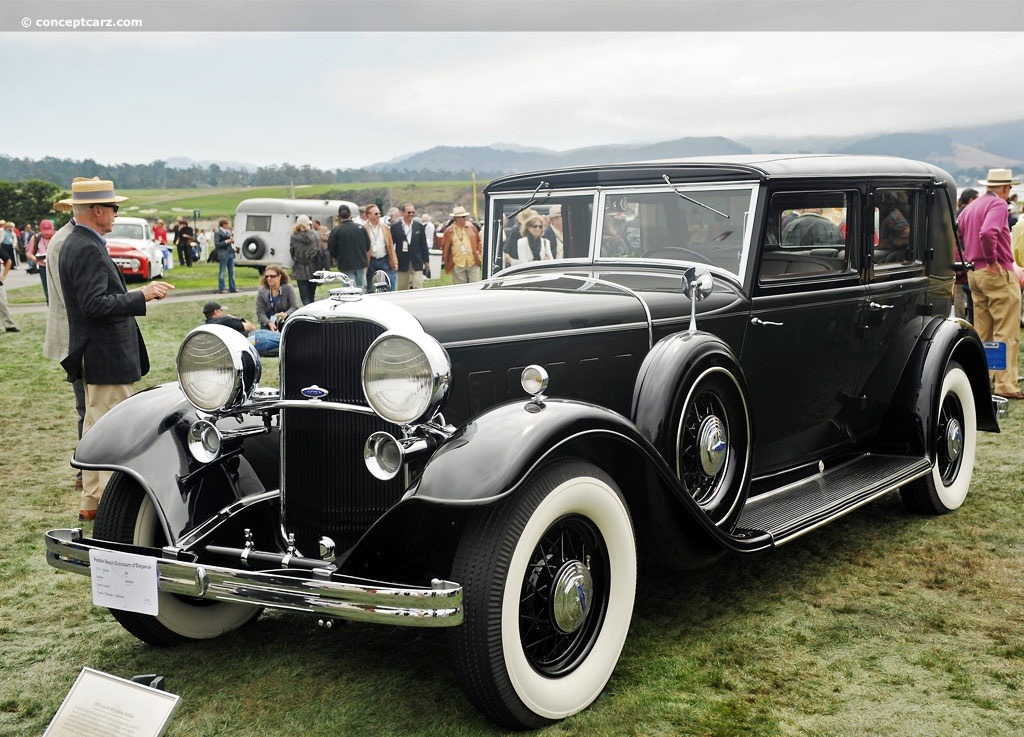
Slightly off the topic of the thread but does this Lincoln still exist? There were two of these Lebaron's built in 1931.


This 1932 KB is sitting in my showroom right now. We're going to do some work on the interior, which has been damaged by mice. A big, handsome, imposing car on a 145-inch wheelbase. Even a simple 4-door sedan looks impressive when it's that big (check out the '35 Ford next to it for a size comparison).

alsancleJan 19, 2016One of the very rare Dietrich sport sedans on the KB chassis.
When I called about it via dealer/museum in Canton he spoke of having a duplicate Dietrich wrecked one too (flipped in a trailer accident or ...).
Yes, he has two. The unrestored/wrecked one was for sale, although I don't know if it is any longer.
Looks better with the blackwalls doesn't it?

Another angle on this very pretty Lebaron I posted before.

Auction on Bring a Trailer:
https://bringatrailer.com/listing/1933-lincoln-ka-victoria-coupe-2/
This 1933 Lincoln KA Victoria coupe is one of 109 examples produced among the approximately 1,110 KA models built that year. It features a one-year-only 382ci V12 and was reportedly last registered for road use in the early 1950s in New York. The selling dealer acquired the car in early 2020 from the second owner, who reportedly had the car disassembled, refinished, and partially reassembled in the 1970s but never completed the project. The engine is said to have been removed and rebuilt at that time but was never started. The coachbuilt body is finished in blue with black fenders and a black roof filler panel, and the interior is trimmed in gray cloth with burl wood accents. This V12-powered Lincoln is now offered as a non-running project with uninstalled parts, service records from the 1970s, New York registration paperwork from the 1940s and 1950s, dealer literature, a Lincoln “Book of Instruction,” a bill of sale, and transferable New York registration.


The ad on BAT is the best I have ever seen for a project car. Very nice automobile.
Wow, that price makes me regret every choice I've made in the last two years.
Matt HarwoodApr 5, 2020Wow, that price makes me regret every choice I've made in the last two years.
That is the price for some of the chrome. It won't sell for that. I'm thinking 25k in the current world. Ed can correct me down 10k.
Also, maybe it is just me, but I strongly prefer the 32 hoods.
alsancleApr 5, 2020That is the price for some of the chrome. It won't sell for that. I'm thinking 25k in the current world. Ed can correct me down 10k.
It will bring 28-32 in current condition........
edinmassApr 5, 2020
It will bring 28-32 in current condition........
How often do you correct me up?
alsancleApr 5, 2020How often do you correct me up?
That’s the first time........ever.
alsancleApr 5, 2020That is the price for some of the chrome. It won't sell for that. I'm thinking 25k in the current world. Ed can correct me down 10k.
I have to bring this to the top since I just noticed it sold for 25k on the dot and Ed was off by 10k.


Cadillac FanFeb 28, 2021
Nice car !!!
John_MerenessFeb 28, 2021Nice car !!!
Fantastic car..........wish it was in my garage.
The then conservator of this magnificent '32 KB showed it at the 1996 LCOC Eastern National Meet in Dearborn, MI. When the owner was showing a group of us and describing that it was a low mileage original including the interior, having that shudder of recognition one gets when one has the opportunity to see such a perfectly preserved original. The same meet included a 1935 Lincoln K five passenger sedan that was just as wonderfully preserved. Also attending that meet were Bob Bourke and Tucker Madawick, both design industry legends.
Why do you suppose Lincoln went from the vent doors to the louvers in 33?

alsancleMar 1, 2021Why do you suppose Lincoln went from the vent doors to the louvers in 33?
Henry saw an interal cost comparison memo!
Is it me or does the body work just seem to flow better on that 1933 than this 1934? I guess it's apples and oranges but the tall green house just looks a little clumsy by comparison.

I don't think that '34 is a factory body.
Oh right, good point. I guess I'm just really taken with '33 sedan. What a nice looking closed car.
Lincoln built a lot of great cars........some attractive, many not so much. The KB is a fantastic platform.
md murrayMar 1, 2021Is it me or does the body work just seem to flow better on that 1933 than this 1934? I guess it's apples and oranges but the tall green house just looks a little clumsy by comparison.
This 1934 has the series-custom Willoughby Type 285 seven passenger limousine body, priced at $5,600, 77 units built. Willoughby bodies tend to be very conservatively styled, think the Panel Brougham which Lincoln catalogued to the end of Model K production.
Regarding the change from the 1932 KB hood doors to the 1933 louvers: because the 1933 was the first to have streamlining applied to the styling, they may have been uncomfortable with the slanted hood doors, fearful their customer's conservative taste consider the feature a bit too much. Saving a minor amount of money on tooling and production may have played a part though given Lincoln was Edsel Ford's vanity project, bleeding red ink by the gallon, difficult to believe financial loss was even a consideration.
58L-Y8Mar 2, 2021This 1934 has the series-custom Willoughby Type 285 seven passenger limousine body, priced at $5,600, 77 units built. Willoughby bodies tend to be very conservatively styled, think the Panel Brougham which Lincoln catalogued to the end of Model K production.
Regarding the change from the 1932 KB hood doors to the 1933 louvers: because the 1933 was the first to have streamlining applied to the styling, they may have been uncomfortable with the slanted hood doors, fearful their customer's conservative taste consider the feature a bit too much. Saving a minor amount of money on tooling and production may have played a part though given Lincoln was Edsel Ford's vanity project, bleeding red ink by the gallon, difficult to believe financial loss was even a consideration.
Steve, The KB was 32/33, did the wheelbase change at all in 34?
alsancleMar 2, 2021Steve, The KB was 32/33, did the wheelbase change at all in 34?
AJ: Lincoln held over the 136" and 145" wheelbases for 1934 of the prior 1933 KA and KB respectively, still designated them as such but added Series 521 to the KA and Series 271 to the KB. Essentially, the chassis was being rationalized to a single series with the 1933 KA Twelve 381.7 ci enlarged to the 414 ci twelve built through the end of the 1939 Model K. For 1935, all became Model K, the 136" wb Series 301; the 145" wb Series 541. For 1936, all still Model K, all regardless of wheelbase Series 300. The 1937-'39 simply Model K, no series designations. Edsel Ford was playing out whatever market still existed for the grandiose Lincolns: 1937: 977; 1938: 416; 1939: 133. Were it not for the independent wealth of the Fords and willingness of Edsel to continue production and probably tolerance by his increasingly paranoid, tyrannical father Henry, Lincoln would have expired by 1936.
As long as Packard continued their Twelve and Cadillac the Sixteen, Edsel had justification to continue the Model K. After all, Fords wanted to continue to be perceived as one of the "Big Three" and no company could claim to do so without a top-line luxury car. Chrysler skirted the issue with their late 1930's Custom Imperials which weren't much more than lwb versions of medium-priced Imperials and other eight cylinder Chryslers. The democratization of the owner-driven luxury car being lead by the Cadillac 60 allowed Chrysler to take this escape route too.
Ask for a simple answer, get a dissertation...
37 Lincoln K. We need to broaden this topic. At Amelia yesterday.

Yes, AJ, the back half of that young woman is attractive. But we don't call them "broads" anymore.
In the Nethercutt Museum.

Can someone tell me if Delage with the Aerosport copied Willoughby or the other way around?
alsancleMay 30, 2021Can someone tell me if Delage with the Aerosport copied Willoughby or the other way around?
AJ: Willoughby drew his design inspiration from the LeTourneur et Marchand bodied Delages and Delahayes pillarless four passenger coupes they had been creating in the mid-'30's. The style began to appear by that time, a 1936 or 1937 Delage L & M coupe appeared in the Hershey Car Corral in the 1990's. You must have seen them at various concours. Unhappily, the late Lincoln K is too large in scale for such a sporting body style to turn out really well. The rear view is particularly unattractive.
58L-Y8May 31, 20211936 or 1937 Delage L & M coupe appeared in the Hershey Car Corral in the 1990's
I remember this car, blue I think with all original interior.
md murrayJun 1, 2021I remember this car, blue I think with all original interior.
We probably need a Delage thread to discuss, but there are a few floating around. All slightly different and all better looking than the Lincoln. Although I would be happy to take the Lincoln home.

It was impossible to get a view of that '38 Lincoln from the side in that museum. I bet rear fender skirts would improve the appearance of the Lincoln.
Craig
The Lincoln K Judkins touring coupe isn't very attractive from the rear view,


Greenhouse is a tad too high.
But, I would still let it sit in my garage.
alsancleJun 5, 2021Greenhouse is a tad too high.
AJ: The spatial relationships between the elements of the Letourneur & Marchand Aerosport are what makes the design work so well. The Judkins has all the elements, just those spatial relationships off enough to make it a less than cohesive design. Still, its a one-off coach-built worthy of preservation.
58L-Y8Jun 6, 2021The Judkins has all the elements, just those spatial relationships off enough to make it a less than cohesive design. Still, its a one-off coach-built worthy of preservation.
It could have benefitted from a longer rear overhang, so the slope from the roof-to-tail could have be more flowing, or 'graceful', befitting the class of the car.
Craig
8E45EJun 7, 2021It could have benefitted from a longer rear overhang, so the slope from the roof-to-tail could have be more flowing, or 'graceful', befitting the class of the car.
Craig
Yes, either longer rear overhang or lower section height or better yet, a combination of both to make the design gracefully flow. Notice the relative low differential height of the hood and molding to the front fender crowns on the Delage. The hood length also comprises greater percentage of the overall proportions as well. Modifying a Lincoln K chassis that extensively before bodying it was likely beyond what Judkins would attempt to achieve the proper proportions.
Many things affecting your view /perception on what you are looking at : 1) the Lincoln has side mounted spares - that adds a bulls eye that stops you eye/flow of the look of the car. Not horrible but a huge factor in what you are looking at. 2) the sweep spear of the belt molding - one plated on a car of one solid dark color , the other sweep spear does not end at the center of the rear fender but kicks up and then continues around the rear fender. Not a bad thing but does affect you vision of the overall design. If the Lincoln was one solid conservative color it would make a huge difference. The green is not "in your face" visually but the highlighted lighted light color at the belt molding is , draws way to much attention. I love both cars, this is just an observation on my part ( I was an art teacher).
Arguably, the best angle that Lincoln has is the way its displayed in the museum, where its most 'obstruction free' from the 3/4 frontal view as seen it my photo.
Craig
"1) the Lincoln has side mounted spares - that adds a bulls eye that stops you eye/flow of the look of the car. Not horrible but a huge factor in what you are looking at."
Exactly the primary reason designers then wanted to conceal the spares in the trunk as soon as possible.
Judkins 3 window coupe coming to market at Amelia.

I spotted this on FaceBook this afternoon, in an ad for a 1928 Packard tractor. Louisville, Ohio.
https://media.invisioncic.com/r277599/monthly_2026_03/Screenshot2026-03-02at4_10_58PM.png.a4acd93cf4747d868d1e8fda54406283.png" src="https://media.invisioncic.com/r277599/monthly_2026_03/Screenshot2026-03-02at4_10_58PM.png.a4acd93cf4747d868d1e8fda54406283.png" height="685" width="914" alt="Screenshot 2026-03-02 at 4.10.58 PM.png" loading='lazy'>
Canton Auto Museum. Looks like they are working on it now. They made a copy of that car which as been sold.
https://media.invisioncic.com/r277599/monthly_2026_03/Lincoln-Dietrich.png.8dc0ed06cdaa6fd42a4b3d7e75600e0e.png" src="https://media.invisioncic.com/r277599/monthly_2026_03/Lincoln-Dietrich.png.8dc0ed06cdaa6fd42a4b3d7e75600e0e.png" height="540" width="811" alt="Lincoln-Dietrich.png" loading='lazy'>
alsancleMar 2, 2026 Canton Auto Museum. Looks like they are working on it now. They made a copy of that car which as been sold.
Which one is the copy? The one in my post?
Walt, good points, yours, previous page. Bill Friedrich, founder of the Packard Club in 1953, was like you, a former high school art teacher. In 1940, he'd visit Dutch Darrin's Sunset Boulevard shop. Clark Gable would come over, he and Darrin talking cars for hours. Bless 'im, an Ian McKellen-ish Bill recalled, "They swore like sailors."
Don't think any domestic cars better crafted than the big Lincolns, chromed brass interior fittings, while Cadillac, Packard, Pierce chromed pot metal. But the big Lincoln's had the most archaic chassis, retaining mechanical brakes, solid front axles, torque tube drive through 1940 because of Henry Ford's stubborn belief in their engineering timelessness. (Enzo Ferrari's insistence on drum brakes gave Jaguar five Le Mans victories in the '50s).
Pierce, Packard, Cad would outperform the big Lincolns, in that order. But that didn't stop me from falling for a gorgeous, subtly luminescent light/medium gray mono-colored '36 Willoughby-garbed Model K sport sedan; four individually adjustable armchair seats surrounded by a symphony of bird's-eye maple, Honduras mahogany or walnut around the windshield and side windows.
https://media.invisioncic.com/r277599/monthly_2026_03/36LincolnKWilloughbysportsedanwith40Packard12020.jpeg.d59b8f0f29f4385cdd7e5bf346cbe26f.jpeg" src="https://media.invisioncic.com/r277599/monthly_2026_03/36LincolnKWilloughbysportsedanwith40Packard12020.jpeg.d59b8f0f29f4385cdd7e5bf346cbe26f.jpeg" height="1208" width="1800" alt="'36 Lincoln K Willoughby sport sedan with '40 Packard 120 20%.jpeg" loading='lazy'>
alsancleMar 2, 2026 Canton Auto Museum. Looks like they are working on it now. They made a copy of that car which as been sold.
A.J.:
Maybe I'll finally get to see a '32 Lincoln Twelve KB Sport Berline by Dietrich restored before I get too old to give a damn.
Steve


Thanks Kent! What a fantastic car that needs to be on the lawn at Pebble. Just needs a million dollars worth of work to get it there.
More proof Lincolns tend to be underrated Classics IMHO.
Can you show some examples of the made up cars?
kar3516Mar 3, 2026
Kent, Thanks for the update. Custom-body conundrum: How did Packard sales management decide to catalogue all the other Dietrich V-windshield body styles except this sport sedan which is clearly based on the convertible sedan structure albeit with a flat windshield, stationary top and victoria-style bustle deck. A sop to Edsel Ford's Lincoln KB program? With a V-windshield in the Packard Individual Custom catalogue, it would have be a stellar choice.
BTW, in the event anyone is curious, the car behind it is a 1946-'48 Cadillac 75 airline transport limousine by Hess & Eisenhardt Co. of Cincinnati, Ohio, built in both 6-door and 8-door configurations.
Milburn DrysdaleMar 9, 2026 Can you show some examples of the made up cars?
Not without getting sued!
To join in the conversation, you must be a club member.
You’re welcome to read and like every post. Members can reply and start topics of their own.

